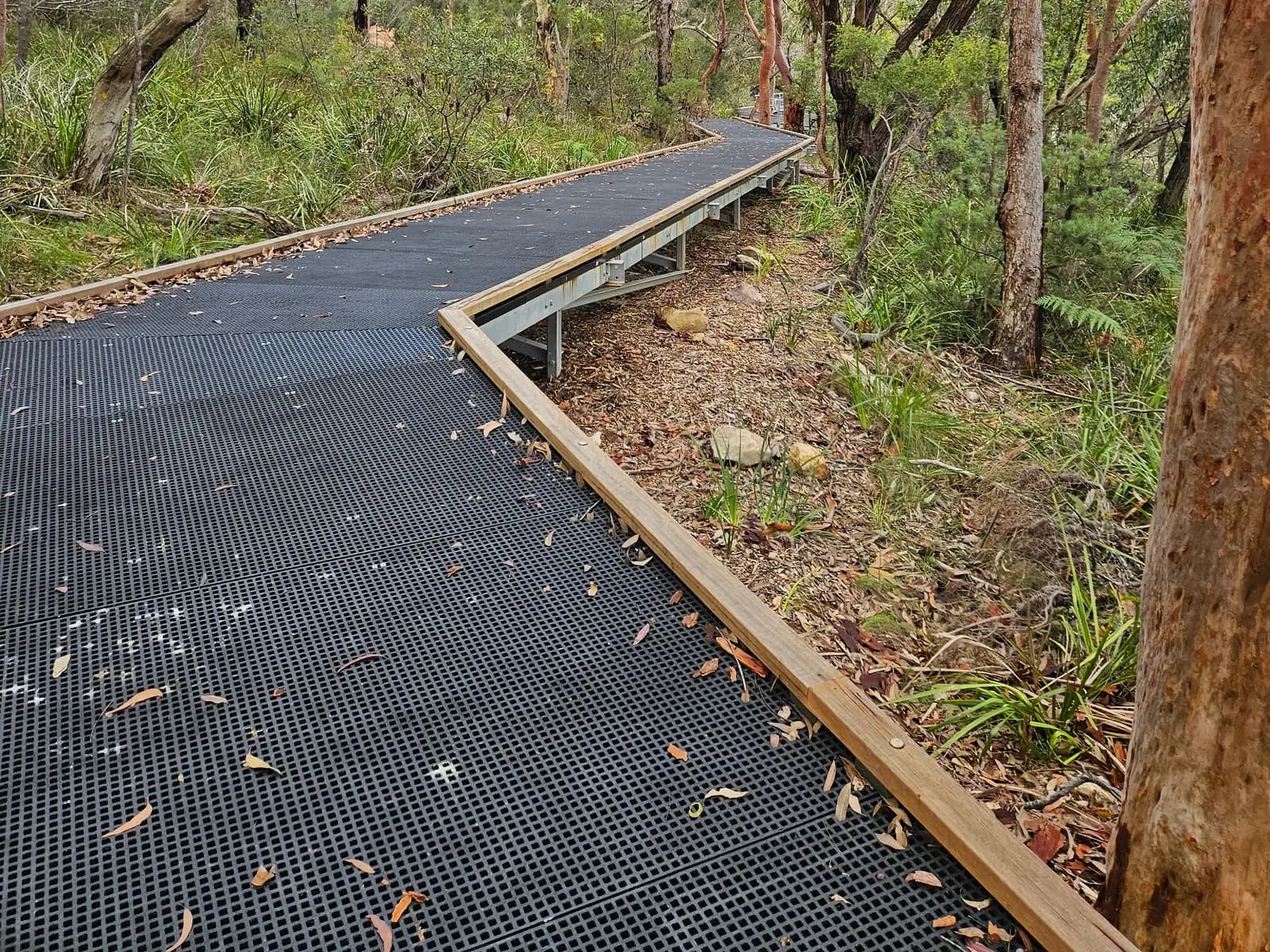
1. FRP vs steel grating: the short answer with numbers
Steel bar grating is stiffer per inch of depth and noncombustible; FRP grating is a third to a half of the weight, and does not corrode or conduct electricity. The table below sets the three common constructions side by side using published manufacturer tables, not generic material properties. The figures are typical catalog values for named products, and the criteria behind them differ between brochures, which section 3 explains.
Three rules decide most projects. First, design to the same criterion: a span from a table based on 1/4 inch deflection at 100 psf cannot be compared with one based on L/120 at 50 psf. Second, specify the resin by exposure, because isophthalic polyester and vinyl ester grating behave very differently in caustic, chlorine and hot service (company data) [S3]. Third, compare installed cost, including lifting, cutting, clips, coating repair and outage time, because the panel price is only part of the decision.
For buyers sourcing from China, two more facts matter. Western brands already source FRP grating there: US Customs classified Chinese FRP grating imported for Bedford Reinforced Plastics under HTS 3925.90.00 in 2016 (official) [S12]. And the trade regime is asymmetric: Chinese steel grating has been under US anti-dumping and countervailing duty orders since 2010, while FRP grating pays tariffs but no trade-remedy duty (official) [S13] [S15].
| Property | Molded FRP, 1-1/2 in, 1-1/2 in square mesh | Pultruded FRP, 1-1/2 in I-bar | Welded steel, 1-1/4 × 3/16 in, 19-W-4 |
|---|---|---|---|
| Weight | 3.8 lb/ft² (18.6 kg/m²), 70% open | 3.0–4.2 lb/ft² (14.6–20.5 kg/m²), 40–60% open | 9.1 lb/ft² (44.4 kg/m²) |
| Pedestrian span, 100 psf and 1/4 in | 36 in tabulated (0.15 in); 42 in gives 0.31 in | 56 in (I-6000) to 62 in (I-4000) | 67 in |
| Load direction | Both directions | Along bearing bars | Along bearing bars |
| Reaction to fire | ASTM E84 Class A, FSI ≤ 25, smoke ≤ 450 | ASTM E84 FSI ≤ 25; phenolic version FSI 10, smoke 10 | Noncombustible |
| Electrical | Nonconductive; conductive-top option to NFPA 77 | Nonconductive | Conductive; must be bonded where required |
| Corrosion | Resin-specific; vinyl ester for strong acids and caustics | Resin-specific; veil gives resin-rich surface | Zinc loss 0.7–8.4 µm/yr in ISO C3–C5 atmospheres |
| Temperature limit | 180 °F vinyl ester; 150 °F isophthalic | 180 °F vinyl ester; 150 °F isophthalic | Not limiting at walkway temperatures |
| US duty from China | 42.8% (3925.90.00) | 42.8% (3925.90.00) | AD up to 145.18% and CVD 62.46% (7308.90.70) |
Source: Strongwell Section 12 [S1]; Fibergrate [S3]; McNichols [S4]; AGA [S11]; CBP and USITC [S12] [S16]; Federal Register [S14] [S15]. Catalog values for named products; GetFRP has not tested them.
2. How molded, pultruded and steel bar grating carry load
Molded FRP grating is cast as one piece with bars running in both directions at full depth. Strongwell describes its molded panels as having load-bearing bars in both directions, which allows use without continuous side support, and Fibergrate notes that holes removing no more than one third of a panel's width need no extra framing because of that bidirectional mesh (company data) [S1] [S2]. The price of that flexibility is a high resin content and, compared with pultruded bars, lower stiffness per pound.
Pultruded FRP grating is assembled from I- or T-shaped bearing bars made of a dense roving core wrapped in continuous mat and a synthetic surfacing veil, locked by pultruded cross rods through the webs. Strongwell states that pultruded bars reach up to 70% glass, which is why they can be used at the same depth as metal grating in most cases, and that the veil gives a 100% resin surface for corrosion and UV protection (company data) [S1]. Load is carried along the bars only, so bars must run from support to support.
Welded steel bar grating follows the same one-way logic: thin rectangular bearing bars at 1-3/16 inch centers in the common 19-W-4 pattern, with twisted cross rods welded across the top (company data) [S4]. The ANSI/NAAMM MBG 531 manual standardizes carbon steel grating design at an allowable stress of 18,000 psi and a modulus of 29,000,000 psi, with recommended maximum spans for 6.4 mm deflection under 4.8 kPa (official industry standard) [S5]. Because steel can be welded, edge banding transfers load between bars; Fibergrate points out that FRP banding cannot, so it is used only to protect against stub bars (company data) [S2].
None of this makes one FRP construction universally better. GetFRP's sourcing guide to pultruded versus molded grating makes the same point: compare the offered products' tables at your span and loads, because the process name alone settles neither capacity nor fire performance.

↔ Scroll horizontally to see the full diagram.
3. FRP and steel grating load tables: spans, deflection criteria and weight
Read every load table with its criterion attached. McNichols lists a pedestrian maximum span for each steel grating as the span that deflects 1/4 inch or less under 100 psf, calculated at 18,000 psi and E = 29,000,000 psi (company data) [S4]. Strongwell's pultruded DURAGRID simple specs use the same 100 psf and 0.25 inch basis, so those two tables compare directly (company data) [S1]. Fibergrate's design guideline instead recommends minimum pedestrian criteria of 50 to 65 psf uniform live load, a 250 lb concentrated load and deflection of L/120 or 3/8 inch, whichever is less; under that lighter basis it finds 1-1/2 inch molded grating acceptable at 36 to 42 inch spans (company data) [S2].
On the common 100 psf and 1/4 inch basis the numbers are clear. Steel GW-100 (1 × 3/16 inch) spans 57 inches, GW-125 (1-1/4 × 3/16) 67 inches and GW-150 (1-1/2 × 3/16) 77 inches (company data) [S4]. Pultruded I-4000 bars span 48, 54 and 62 inches at 1, 1-1/4 and 1-1/2 inch depth, I-6000 bars 44, 49 and 56 inches, and a 2 inch T-5000 bar 65 inches (company data) [S1]. Strongwell's molded 1-1/2 inch square mesh deflects 0.15 inch at a 36 inch span and 0.31 inch at 42 inches under 100 psf, so its pedestrian span on this criterion lies between those two table steps (company data) [S1].
Weight runs the other way. The same steel gratings weigh 7.5, 9.1 and 10.8 lb/ft² (36.6, 44.4 and 52.7 kg/m²), while pultruded I-4000 at 1-1/2 inch weighs 4.2 lb/ft² and molded 1-1/2 inch square mesh 3.8 lb/ft² (company data; GetFRP unit conversion at 4.882 kg/m² per lb/ft²) [S4] [S1]. So the pultruded bar that comes within 5 inches of the steel span weighs 46% of it (estimate: 4.2 / 9.1).
Three caveats belong in the specification. FRP tables are for static loads at ambient temperature; Fibergrate limits impact loads to half the tabulated values and asks for consultation at elevated temperature (company data) [S3]. Steel serrations cost depth: a serrated 1-1/2 inch bar is rated like a smooth 1-1/4 inch bar (company data) [S4]. And wheel loads need their own check: the tabulated pedestrian spans say nothing about carts or forklifts.
↔ Scroll horizontally to see the full chart and data table.
Source: McNichols GW load table [S4]; Strongwell Design Manual Section 12, Rev. 0425 [S1]. Steel and pultruded values are the manufacturers' stated pedestrian spans. Molded values are the longest tabulated span (6 inch steps) whose deflection at 100 psf stays at or below 0.25 inch; the true limit lies between that step and the next.
View the chart data and evidence
| Series | Category | Value | Unit | Evidence / value basis | Reported range | Point note |
|---|---|---|---|---|---|---|
| — | Steel GW-150, 1-1/2 × 3/16 in | 77 | in | Company data | — | — |
| — | Steel GW-125, 1-1/4 × 3/16 in | 67 | in | Company data | — | — |
| — | Pultruded FRP T-5000, 2 in | 65 | in | Company data | — | — |
| — | Pultruded FRP I-4000, 1-1/2 in | 62 | in | Company data | — | — |
| — | Steel GW-100, 1 × 3/16 in | 57 | in | Company data | — | — |
| — | Pultruded FRP I-6000, 1-1/2 in | 56 | in | Company data | — | — |
| — | Pultruded FRP I-4000, 1 in | 48 | in | Company data | — | — |
| — | Molded FRP 2 in, 2 × 2 in mesh (last table step within criterion) | 42 | in | Company data | — | — |
| — | Molded FRP 1-1/2 in, 1-1/2 in mesh (last table step within criterion) | 36 | in | Company data | — | — |
| — | Molded FRP 1 in, 1-1/2 in mesh (last table step within criterion) | 24 | in | Company data | — | — |
↔ Scroll horizontally to see the full chart and data table.
Source: McNichols [S4]; Strongwell [S1]; GetFRP conversion from lb/ft². Catalog weights converted at 1 lb/ft² = 4.882 kg/m². Pultruded weights assume cross rods at 6 inch centers.
View the chart data and evidence
| Series | Category | Value | Unit | Evidence / value basis | Reported range | Point note |
|---|---|---|---|---|---|---|
| — | Steel GW-150, 1-1/2 × 3/16 in | 52.7 | kg/m² | Company data | — | — |
| — | Steel GW-125, 1-1/4 × 3/16 in | 44.4 | kg/m² | Company data | — | — |
| — | Steel GW-100, 1 × 3/16 in | 36.6 | kg/m² | Company data | — | — |
| — | Molded FRP 1-1/2 in mini-mesh, 44% open | 22 | kg/m² | Company data | — | — |
| — | Pultruded FRP I-4000, 1-1/2 in | 20.5 | kg/m² | Company data | — | — |
| — | Molded FRP 2 in, 2 × 2 in mesh | 19.5 | kg/m² | Company data | — | — |
| — | Molded FRP 1-1/2 in, 1-1/2 in mesh | 18.6 | kg/m² | Company data | — | — |
| — | Pultruded FRP T-5000, 2 in | 15.1 | kg/m² | Company data | — | — |
| — | Pultruded FRP I-6000, 1-1/2 in | 14.6 | kg/m² | Company data | — | — |
| — | Molded FRP 1 in, 1-1/2 in mesh | 12.7 | kg/m² | Company data | — | — |
| Product | Depth | Bar or mesh | Open area | Weight (lb/ft²) | Span at criterion | Criterion | Source |
|---|---|---|---|---|---|---|---|
| Molded FRP, Strongwell DURAGRATE | 1 in | 1-1/2 in square | 70% | 2.6 | 24 in (0.12 in deflection) | 100 psf, ≤ 0.25 in | [S1] |
| Molded FRP, Strongwell DURAGRATE | 1-1/2 in | 1-1/2 in square | 70% | 3.8 | 36 in (0.15 in) | 100 psf, ≤ 0.25 in | [S1] |
| Molded FRP, Strongwell DURAGRATE | 2 in | 2 in square | 72% | 4.0 | 42 in (0.17 in) | 100 psf, ≤ 0.25 in | [S1] |
| Molded FRP, Fibergrate guideline | 1-1/2 in | 1-1/2 in square | 70% | 3.8 | 36–42 in | 50–65 psf, L/120 or 3/8 in | [S2] [S3] |
| Pultruded FRP, Strongwell I-4000 | 1-1/2 in | 1 in centers | 40% | 4.2 | 62 in | 100 psf, 0.25 in | [S1] |
| Pultruded FRP, Strongwell I-6000 | 1-1/2 in | 1-1/2 in centers | 60% | 3.0 | 56 in | 100 psf, 0.25 in | [S1] |
| Pultruded FRP, Strongwell T-5000 | 2 in | 2 in centers | 50% | 3.1 | 65 in | 100 psf, 0.25 in | [S1] |
| Welded steel, McNichols GW-100 | 1 in | 3/16 in bar, 19-W-4 | not stated | 7.5 | 57 in | 100 psf, ≤ 1/4 in; 18,000 psi | [S4] |
| Welded steel, McNichols GW-125 | 1-1/4 in | 3/16 in bar, 19-W-4 | not stated | 9.1 | 67 in | 100 psf, ≤ 1/4 in; 18,000 psi | [S4] |
| Welded steel, McNichols GW-150 | 1-1/2 in | 3/16 in bar, 19-W-4 | not stated | 10.8 | 77 in | 100 psf, ≤ 1/4 in; 18,000 psi | [S4] |
Source: Manufacturer load tables as cited; typical catalog values for those products. Molded spans are table steps, not interpolated limits.
4. Installation weight, handling and labor
Weight is where FRP pays back first. Fibergrate describes its molded grating as less than one half the weight of steel grating, allowing removal for access below floor level and installation with no heavy equipment and fewer people (company data) [S3]. The catalog numbers bear it out: a 4 × 12 ft panel of 1-1/2 inch molded FRP at 3.8 lb/ft² is about 182 lb (83 kg), while the same panel in 1-1/4 × 3/16 inch welded steel at 9.1 lb/ft² is about 437 lb (198 kg) (estimate from company data) [S1] [S4]. On a retrofit inside an operating plant, that difference decides whether panels are carried by hand or need lifting gear and hot-work permits.
Fixing and fabrication rules differ by material. Fibergrate specifies at least two hold-down clips per support at no more than 4 ft centers and at least four clips per panel, F-clips at 24 inch maximum spacing where molded panel edges abut without a support, and cantilevers of no more than 6 inches for 1 inch molded grating and 12 inches for 1-1/2 and 2 inch grating (company data) [S2]. Strongwell's pultruded grating is cut like a solid sheet; the cut ends are coated with resin sealer before installation (company data) [S1]. Steel grating is cut and banded in the shop; field cuts break the galvanizing and need zinc-rich repair.
Panel logistics also differ. Strongwell's molded panels come in 3 × 10, 4 × 12 and 5 × 10 to 5 × 12 ft sizes and its pultruded panels up to 60 × 240 inches, and Fibergrate recommends laying out supports at 36 or 48 inches to use stock molded panels efficiently (company data) [S1] [S2]. Planning the steel spacing around the grating, rather than the reverse, is the cheapest weight saving available.

5. Fire rating, slip resistance, conductivity and UV
Fire is the main reason steel is still specified in some areas. Standard fire-retardant FRP grating is tested to ASTM E84: Strongwell's vinyl ester and isophthalic molded grating reaches Class A with a flame-spread index of 25 or less and smoke developed of 450 or less, tested with the flame on the top and the bottom face (company data) [S1]. Fibergrate's XFR vinyl ester reaches a flame-spread index of 10 or less, and its ELS acrylic-modified system combines a flame-spread index of 25 or less with smoke developed of 100 or less for tunnels and offshore (company data) [S3]. Strongwell's phenolic pultruded grating rates 10 for flame spread and 10 for smoke, UL 94 V-0, and is accepted for Structural Fire Integrity Level 2 under the ASTM F3059 matrix used for ships and offshore units (company data) [S1]. Surface burning class is not structural fire resistance; if a walkway must carry load in a fire, specify the L-level or a tested assembly.
Slip resistance comes from the top surface. Fibergrate molded grating uses a concave meniscus top as standard and an integrally applied quartz grit as an option, and Strongwell bonds a grit-baked epoxy surface onto pultruded bars (company data) [S3] [S1]. For steel, serrated bars provide grip at the cost of a quarter inch of effective depth (company data) [S4].
Electrically, FRP grating is nonconductive, which is the reason it is used around substations, electrolysis cells and battery rooms (company data) [S3]. Where static must be drained instead, Fibergrate makes a conductive-top molded grating to NFPA 77 guidance with average surface resistivity of 2.5 × 10³ to 1 × 10⁶ ohms per lineal foot and resistance to ground below 10⁸ ohms, with at least four grounding attachments per section (company data) [S3]. Steel needs the opposite design: bonding and grounding.
Ultraviolet light attacks unprotected resin-rich surfaces. Every Strongwell molded resin contains a UV inhibitor and its pultruded bars carry a synthetic veil plus UV inhibitor; Fibergrate offers an HSUV system for offshore exposure and recommends a polyurethane UV coating for outdoor railings (company data) [S1] [S3] [S2]. Ask Chinese suppliers to state the inhibitor and veil in writing, because fiber bloom on unveiled outdoor FRP is the failure buyers notice first.
| System | Resin | ASTM E84 flame spread | Smoke developed | Other ratings | Source |
|---|---|---|---|---|---|
| Strongwell DURAGRATE molded | Vinyl ester or isophthalic, fire retardant | Class A, ≤ 25 | ≤ 450 | Tested flame-on-top and flame-on-bottom | [S1] |
| Strongwell DURADEK pultruded | Fire-retardant polyester with antimony trioxide, or vinyl ester | ≤ 25 (Class 1) | not stated | Self-extinguishing per ASTM D635 | [S1] |
| Strongwell DURAGRID Phenolic | Phenolic | 10 | 10 | UL 94 V-0; ASTM F3059 Level 2; IMO FTP smoke and toxicity | [S1] |
| Fibergrate Vi-Corr / Corvex | Vinyl ester / isophthalic | ≤ 25 | not stated | Vi-Corr: DNV and ABS type approvals; Corvex: USCG general fire rating | [S3] |
| Fibergrate XFR | Fire-retardant vinyl ester | ≤ 10 | not stated | Recommended where fire potential is high | [S3] |
| Fibergrate ELS | Acrylic-modified polyester | ≤ 25 | ≤ 100 | Low smoke toxicity for tunnels and transit | [S3] |
Source: Strongwell Section 12 [S1] and Fibergrate molded products brochure [S3]. Reaction-to-fire classes for named products; request the report for the exact construction offered.
6. Chemical resistance by resin: isophthalic, vinyl ester and phenolic vs galvanized steel
FRP grating is only as corrosion resistant as its resin. In Fibergrate's published guide, its Vi-Corr vinyl ester is rated for continuous exposure to 30% hydrochloric acid, 50% sulfuric acid, 50% sodium hydroxide, wet chlorine at the maximum service temperature and 10% sodium hypochlorite at 100 °F, while its Corvex isophthalic polyester is limited to splashes in hydrochloric and sulfuric acid and to infrequent spills of sodium hydroxide, and is not recommended for wet chlorine (company data) [S3]. The maximum service temperature is 180 °F for Vi-Corr and pultruded vinyl ester and 150 °F for Corvex, the food-grade isophthalic and pultruded isophthalic systems (company data) [S3]. Phenolic grating is chosen for fire and smoke, not for chemical resistance.
Galvanized steel corrodes at a rate set by the atmosphere. The American Galvanizers Association reproduces the ISO 9223 first-year zinc corrosion rates: 0.7 to 2.1 µm/yr in category C3, 2.1 to 4.2 in C4, 4.2 to 8.4 in C5 and 8.4 to 25 in CX (industry association) [S11]. A 100 µm coating therefore lasts roughly 48 to 143 years in C3 but only 12 to 24 years in C5 and 4 to 12 years in CX before the zinc is consumed (estimate: 100 µm divided by each rate range). AGA's own chart puts 1/4 inch steel with the ASTM A123 minimum of 3.9 mils (100 µm) at about 72 years to first maintenance in an industrial atmosphere, and stresses that the chart does not apply to immersion or soil (industry association) [S10].
Those zinc numbers describe atmospheres, not chemical splash. In wastewater headworks, chlorine contact chambers, pickling lines or caustic areas, galvanizing is attacked directly and the useful comparison is the FRP resin rating against the actual chemical, concentration and temperature. Fibergrate asks end users to test under actual conditions because chemical mixtures occur in service, which is the right standard to demand from any supplier (company data) [S3].
↔ Scroll horizontally to see the full chart and data table.
Source: GetFRP calculation from ISO 9223 zinc rates published by the American Galvanizers Association [S11]. Years = 100 µm / rate. First-year rates usually overstate long-term loss; AGA gives 47–143 years to first maintenance for C3. Atmospheric exposure only; chemical splash and immersion are not covered.
View the chart data and evidence
| Series | Category | Value | Unit | Evidence / value basis | Reported range | Point note |
|---|---|---|---|---|---|---|
| At the fast end of the rate range | C3 medium | 48 | years | GetFRP estimate | — | — |
| At the fast end of the rate range | C4 high | 24 | years | GetFRP estimate | — | — |
| At the fast end of the rate range | C5 very high | 12 | years | GetFRP estimate | — | — |
| At the fast end of the rate range | CX extreme | 4 | years | GetFRP estimate | — | — |
| At the slow end of the rate range | C3 medium | 143 | years | GetFRP estimate | — | — |
| At the slow end of the rate range | C4 high | 48 | years | GetFRP estimate | — | — |
| At the slow end of the rate range | C5 very high | 24 | years | GetFRP estimate | — | — |
| At the slow end of the rate range | CX extreme | 12 | years | GetFRP estimate | — | — |
| Chemical environment | Concentration | Vinyl ester (Vi-Corr) | Isophthalic (Corvex) | Fire-retardant iso, pultruded (ISOFR) |
|---|---|---|---|---|
| Hydrochloric acid | 30% | Continuous | Splash | Infrequent spill |
| Sulfuric acid | 50% | Continuous | Splash | Not recommended |
| Sodium hydroxide | 50% | Continuous | Infrequent spill | Not recommended |
| Sodium hypochlorite (stable) | 10%, 100 °F | Continuous | Splash | Infrequent spill |
| Chlorine, wet | Saturated | Continuous | Not recommended | Not recommended |
| Nitric acid | 20%, 120 °F | Continuous | Splash | Infrequent spill |
| Acetone | 100%, 75 °F | Splash | Infrequent spill | Not recommended |
| Water (fresh, salt) | 100% | Continuous | Continuous | Continuous |
| Maximum service temperature | 180 °F | 150 °F | 150 °F (pultruded ISOFR) |
Source: Fibergrate molded products brochure, corrosion guide [S3]. Ratings at the maximum temperature unless a temperature is shown; Fibergrate asks users to test under actual conditions.
7. FRP vs steel grating lifecycle cost: what can be priced and what cannot
Price evidence for grating is thin and mostly commercial, so a lifecycle comparison should be built from the buyer's own quotes on a common scope. What is published for China is listing data: Hengrun Group in Hengshui lists 38 × 38 mm molded polyester grating at USD 26.80 per square meter with a 10 m² minimum, and a Hebei seller trading as LongTime lists 38 mm molded grating at USD 35/m² from 100 m² and USD 33/m² from 200 m² (company listings, read 3 November 2026) [S22] [S23]. US duty at 42.8% adds about USD 11.50 to 15.00 per m² on that range before freight (estimate: 0.428 × USD 26.80–35).
The steel side of a lifecycle model is driven by coating life and outage cost rather than panel price. Section 6 shows that a 100 µm galvanized coating lasts roughly 12 to 24 years in a C5 atmosphere and 4 to 12 years in CX, while FRP grating in a resin rated for the exposure needs no coating cycle (estimate) [S11] [S3]. In a mild C3 atmosphere the same zinc lasts 48 years or more, and galvanized steel is usually the lower-cost choice. The break-even is therefore an exposure question first and a price question second.
Build the comparison with these lines and discount them at your own rate: panel price ex-works; duty and freight by weight, which favors FRP at about 40% of steel's mass; installation crew and lifting; field cutting, clips and edge treatment; inspection; recoating or replacement events; and the cost of shutting down the area underneath. GetFRP's earlier version of this page used index numbers rather than prices; they have been removed because no sourced input supported them.
| Input | FRP grating | Galvanized steel grating | Source or status |
|---|---|---|---|
| Panel price, China | USD 26.80–35/m², 38 mm molded (listings) | Not captured in this update | Company listings [S22] [S23] |
| US duty from China | 42.8% (3925.90.00) | AD up to 145.18% and CVD 62.46% on top of tariffs | [S12] [S14] [S15] [S16] |
| Mass to ship and lift | 18.6 kg/m² (1-1/2 in molded) | 44.4 kg/m² (1-1/4 × 3/16 in welded) | [S1] [S4] |
| Coating cycle in C5 atmosphere | None if resin rated for exposure | Zinc consumed in about 12–24 years | Estimate from [S11] |
| Temperature or fire limits | 150–180 °F; Class A surface burning | Noncombustible | [S3] [S1] |
| Installation crew and lifting | Buyer to quote | Buyer to quote | Not published |
| Outage cost for maintenance | Buyer to estimate | Buyer to estimate | Site-specific |
Source: Values as cited; GetFRP did not collect installed-cost quotations. Use dated bids on one written scope.
8. OSHA, ADA and code requirements for grating walkways
OSHA's walking-working surfaces rule is performance-based. Under 29 CFR 1910.22, each walking-working surface must support the maximum intended load for that surface, be kept free of hazards such as sharp or protruding objects, and be inspected regularly and as necessary and maintained in a safe condition (official) [S6]. That makes the design load, the deflection criterion and an inspection plan the compliance deliverables, whatever the material. 1910.23, often cited alongside it, covers ladders only, with rung spacing of 10 to 14 inches; it does not regulate grating (official) [S8].
Openings are defined, too. OSHA treats a hole as a gap or open space in a floor or similar surface at least 2 inches in its least dimension, so standard 1-1/2 inch mesh and bar grating are walking surfaces rather than holes (official) [S7]. Public routes are stricter: the 2010 ADA Standards for Accessible Design, section 302.3, do not allow floor openings that pass a sphere of more than 1/2 inch diameter, and elongated openings must run perpendicular to the dominant direction of travel (official) [S9]. Standard 70% open molded grating does not meet that; mini-mesh or covered grating, or close-mesh steel, is needed.
For steel, ANSI/NAAMM MBG 531 adds operation and maintenance instructions: keep wheel and other loads within the rating, inspect periodically for corrosion, finish damage, deformation and bearing bar lean, and replace missing fasteners (official industry standard) [S5]. For FRP, Strongwell specifies grating to the standards of the Fiberglass Grating Manufacturers Council, and for marine and offshore use the ASTM F3059 fire-integrity levels apply (company data) [S1].
9. Sourcing FRP grating from China: the Hebei cluster, standards and quality risks
China's grating supply is concentrated. The China Composites Industry Association describes Zaoqiang county in Hengshui, Hebei, as the country's largest composites production base, with more than 500 registered composites enterprises and about 200 more that have built plants elsewhere (industry association, January 2024) [S21]. The Hengrun and LongTime listings cited above both ship from Hebei (company listings) [S22] [S23], and the grating makers profiled on GetFRP sit in two clusters: Zaoqiang and Hengshui in Hebei, and Wuxi, Rugao and Yizheng in Jiangsu.
Chinese standards cover the product, though less completely than for steel. JC/T 1026-2007, the building-materials industry standard for glass-fiber-reinforced thermosetting resin load-bearing grating, has been in force since 1 October 2007, while steel grating has a current series, YB/T 4001.1-2019 for steel grating panels in force since 1 January 2020 with parts for stair treads and guardrails (official) [S19]. A query of the national GB registry finds no national product standard for FRP walkway grating, only GB/T 37256-2018 for outdoor building grilles, so export buyers should specify to ASTM E84, ASTM F3059 where relevant, and the load-table criterion of their design code (official) [S20]. CB/T 4566-2025, a new shipbuilding standard for marine gratings in force since 1 November 2025, is worth asking about for marine orders; confirm its material scope before citing it (official) [S19].
The quality risks are predictable. The most common are resin substitution, such as orthophthalic polyester offered where isophthalic or vinyl ester was specified; fire claims backed by a resin data sheet rather than an ASTM E84 report on the actual panel; low glass content in molded panels; grit that wears off; and missing UV inhibitor or veil. Verify with a burn-off glass content test, a three-point panel load test at your span, the E84 report naming the product and thickness, a resin batch certificate traceable to the panel, and a pre-shipment inspection of dimensions and grit adhesion.
GetFRP supplier profiles for grating
Hebei Tengjun in Zaoqiang lists FRP grating with cable tray, profiles and rebar and says it exports to more than 60 countries; Hebei Weitong in Hengshui lists grating and pultruded profiles; Sino Composite Structures in Wuxi started with molded grating and now offers molded, pultruded and phenolic grating with handrail systems; Jiuding, listed in Shenzhen as 002201, and Nanjing Spare publish pultruded profiles and gratings. All capability statements are company-published; GetFRP has not audited these plants.
10. Trade measures: US duties on Chinese steel and FRP grating
Steel grating from China has been under US anti-dumping and countervailing duty orders since 23 July 2010. The scope covers steel grating of two or more pieces joined by any process, regardless of size, metallurgy, profile or coating, classified under HTS 7308.90.70, and excludes expanded metal and plank-type safety grating (official) [S13]. The 2021 sunset review found dumping margins up to 145.18% likely to prevail, and the expedited third sunset review of the countervailing order, published 9 September 2026, found a 62.46% subsidy rate for Ningbo Jiulong Machinery and all other producers (official) [S14] [S15]. The MFN rate on steel grating is free (official) [S17].
FRP grating sits outside that scope because it is not steel. US Customs classified Chinese FRP grating under HTS 3925.90.00, builders' ware of plastics, at 5.3% (official) [S12] [S18]. That subheading is on Section 301 List 3 at 25% under heading 9903.88.03, and Chinese goods also pay the 12.5% country tariff of heading 9903.05.31 from 24 July 2026, for 42.8% in total (official; GetFRP sum) [S16]. No anti-dumping or countervailing order on FRP grating appears in the Federal Register sources reviewed; markets outside the US were not re-verified for this update.
| Product | HTS | Measure | Rate | Status and source |
|---|---|---|---|---|
| Steel grating | 7308.90.70 | MFN | Free | Official schedule [S17] |
| Steel grating | 7308.90.70 | Anti-dumping order A-570-947 | Margins up to 145.18% likely to prevail (2021 sunset) | In force since 23 Jul 2010; continued 1 Jun 2021 [S13] [S14] |
| Steel grating | 7308.90.70 | Countervailing order C-570-948 | 62.46% | Third sunset results 9 Sep 2026 [S15] |
| FRP grating | 3925.90.00 | MFN | 5.3% | CBP ruling N281025; current schedule [S12] [S18] |
| FRP grating | 3925.90.00 | Section 301 List 3 (9903.88.03) | 25% | In force [S16] |
| FRP grating | 3925.90.00 | Country tariff (9903.05.31) | 12.5% | From 24 Jul 2026 [S16] |
| FRP grating | 3925.90.00 | Anti-dumping or countervailing duty | None found | Steel grating scope covers steel only [S13] |
Source: Federal Register, US Customs CROSS and USITC HTS 2026 revision 22. Confirm live rates and any company-specific deposit rate with a licensed customs broker before import.
11. FRP grating RFQ checklist
An RFQ that fixes the load case, the criterion, the resin and the evidence gets comparable quotes from Chinese and Western suppliers alike. The numbered requirements below set values where published references exist.
| # | Requirement | Value or evidence to request |
|---|---|---|
| 1 | Load case and criterion | Uniform load (e.g. 100 psf) and deflection limit (e.g. 1/4 in or L/200) stated; concentrated and wheel loads listed separately |
| 2 | Construction | Molded (depth, mesh) or pultruded (bar series, depth, bar centers, cross-rod spacing) |
| 3 | Load table | Manufacturer table for the offered product with the criterion printed; span at your support spacing |
| 4 | Resin | Isophthalic, vinyl ester or phenolic named; resin brand and grade; corrosion rating for each chemical, concentration and temperature |
| 5 | Temperature | Maximum service temperature at or above process temperature (150 °F isophthalic, 180 °F vinyl ester references) |
| 6 | Fire | ASTM E84 report for the offered panel: flame spread ≤ 25 (or ≤ 10), smoke value; ASTM F3059 level for marine or offshore |
| 7 | Surface | Meniscus or grit top; grit type and bonding; open area; ADA 1/2 inch sphere rule if a public route |
| 8 | UV | UV inhibitor in resin and surfacing veil on pultruded bars, stated in writing |
| 9 | Electrical | Nonconductive, or conductive top to NFPA 77 with surface resistivity and resistance-to-ground values |
| 10 | Glass content | Burn-off test report (ASTM D2584 or ISO 1172) against the supplier's stated range |
| 11 | Panel test | Three-point load test of a production panel at the design span before shipment |
| 12 | Fabrication | Cut plan, resin sealing of cut edges, clip type and count (≥ 4 per panel, ≤ 4 ft per support) |
| 13 | Packing and marking | Panel IDs matching the layout drawing; pallet weights for handling |
| 14 | Trade terms | HS 3925.90 declared, Incoterm, origin documents; duty basis shown on the quote |
Source: GetFRP procurement checklist built on Strongwell [S1], Fibergrate [S2] [S3], ADA [S9] and the trade sources in section 10.
Frequently asked questions
Is FRP grating as strong as steel grating?
Not per inch of depth, but often enough at walkway spans. At 100 psf and 1/4 inch deflection, McNichols rates 1-1/4 × 3/16 inch welded steel at 67 inches and Strongwell rates its 1-1/2 inch pultruded I-4000 FRP at 62 inches and a 2 inch T-5000 at 65 inches. Molded 1-1/2 inch FRP stays within the criterion at 36 inches. Check impact and wheel loads separately; FRP tables are for static loads at ambient temperature.
How much lighter is FRP grating than steel?
About 40% to 46% of the weight of 1-1/4 inch steel grating. 1-1/2 inch molded FRP weighs 3.8 lb/ft² (18.6 kg/m²) and 1-1/2 inch pultruded I-4000 4.2 lb/ft², against 9.1 lb/ft² (44.4 kg/m²) for 1-1/4 × 3/16 inch welded steel. A 4 × 12 ft panel is about 83 kg in molded FRP and 198 kg in that steel grating.
What span can 1-1/2 inch FRP grating cover?
It depends on construction and criterion. At 100 psf and 1/4 inch, Strongwell pultruded 1-1/2 inch I-bar grating spans 56 to 62 inches, while its 1-1/2 inch molded square mesh deflects 0.15 inch at 36 inches and 0.31 inch at 42 inches. Under Fibergrate's lighter guideline of 50 to 65 psf and L/120 or 3/8 inch, 1-1/2 inch molded grating is acceptable at 36 to 42 inches.
Is FRP grating fire rated?
Standard fire-retardant FRP grating is Class A for surface burning under ASTM E84, with a flame-spread index of 25 or less; premium systems reach 10 or less, and phenolic grating rates 10 for flame spread and 10 for smoke. That is reaction to fire, not structural fire resistance. For ships and offshore, specify the ASTM F3059 structural fire integrity level, such as Level 2 for phenolic grating.
Which FRP grating resin should I use in a chemical plant?
Vinyl ester for strong acids, caustics and chlorine: Fibergrate rates its vinyl ester for continuous exposure to 30% hydrochloric acid, 50% sodium hydroxide and wet chlorine up to 180 °F. Isophthalic polyester suits milder service and splashes, with a 150 °F limit, and is not recommended for wet chlorine. Phenolic is chosen for fire and smoke performance.
Does FRP grating meet OSHA requirements?
OSHA 1910.22 is performance-based: the surface must support its maximum intended load, be free of hazards and be inspected and maintained. FRP or steel grating complies when designed to the intended load with a stated deflection limit and fixed as specified. OSHA treats openings of 2 inches or more as holes, so 1-1/2 inch mesh is a walking surface; 1910.23 covers ladders, not grating. Public routes must also meet the ADA 1/2 inch opening rule.
Is there anti-dumping duty on FRP grating from China?
Not in the US. The anti-dumping and countervailing orders on Chinese grating cover steel grating only, with margins up to 145.18% and a 62.46% subsidy rate. FRP grating is classified under HTS 3925.90.00 at 5.3%, plus 25% Section 301 and the 12.5% country tariff from 24 July 2026, about 42.8% in total.
How much does FRP grating cost from China?
Hebei sellers listed 38 mm molded polyester grating at USD 26.80 to 35 per square meter in November 2026, with minimums of 10 to 100 m² and lower prices at higher volume. Vinyl ester, phenolic, pultruded and fire-tested grades cost more, and US duty of about 42.8% plus freight must be added. Treat listings as indicative and request dated quotes on your specification.
Sources and scope
Figures were cross-checked against primary documents where available; secondary citations are marked in each scope note. Company figures are reported as disclosed by the companies themselves. This note is an independent market assessment and not investment advice.
- [S1]Strongwell, Design Manual Section 12: Fiberglass Grating (Rev. 0425, 2025)
DURAGRATE molded panel weights, open areas and uniform load/deflection tables; DURAGRID I- and T-bar pedestrian spans at 100 psf and 0.25 in; ASTM E84 classes; phenolic data (FSI 10, smoke 10, UL 94 V-0, ASTM F3059 L2); up to 70% glass in pultruded bars; panel sizes; cut-edge sealing. Company data; same values as Rev. 1123.
- [S2]Fibergrate Composite Structures, Guidelines for the Engineer and Designer
Minimum pedestrian criteria (50–65 psf, 250 lb, L/120 or 3/8 in); molded span guidance by depth; cantilevers; hold-down clip rules; holes up to one third of panel width; edge banding not structural. Company guidance.
- [S3]Fibergrate Composite Structures, molded FRP products brochure
Molded grating weights; less than half the weight of steel claim; resin systems (Vi-Corr, Corvex, FGI-AM, XFR, ELS, Super Vi-Corr) with E84 values; conductive grating per NFPA 77; HSUV; corrosion guide with C/S/I/N ratings and 180/150 °F maximum temperatures; static and impact load notes. Company data.
- [S4]McNichols, GW and GW-2 series welded carbon and galvanized steel bar grating load table (19-W-4 and 19-W-2)
Uniform and concentrated loads and deflections by clear span; pedestrian max spans (1/4 in at 100 psf); weights per ft²; 18,000 psi and E = 29,000,000 psi basis; serrated-bar rule. Company data, theoretical.
- [S5]ANSI/NAAMM MBG 531-17, Metal Bar Grating Manual, 8th edition (copy hosted by Vulcraft)
Carbon steel tables at F = 18,000 psi, E = 29,000,000 psi (ASTM A1011 CS Type B); recommended max spans for 6.4 mm deflection under 4.8 kPa; operation and maintenance instructions. A 2024 edition may supersede it.
- [S6]OSHA, 29 CFR 1910.22 Walking-working surfaces, general requirements
Surfaces support their maximum intended load; free of hazards; inspected and maintained. Official regulation (81 FR 82983, 2016).
- [S7]OSHA, 29 CFR 1910.21 Scope and definitions
Definitions of walking-working surface and hole (at least 2 inches in least dimension). Official regulation.
- [S8]OSHA, 29 CFR 1910.23 Ladders
Scope limited to ladders; rung spacing 10–14 in. Cited to correct the common pairing of 1910.23 with grating. Official regulation.
- [S9]US Access Board, 2010 ADA Standards for Accessible Design
Section 302.3: floor openings may not pass a 1/2 inch sphere; elongated openings perpendicular to travel. Official standard.
- [S10]American Galvanizers Association, Time to first maintenance chart for hot-dip galvanized coatings (2010)
About 72 years to first maintenance for 1/4 in steel with 3.9 mils (ASTM A123 minimum) in an industrial atmosphere; definition of first maintenance (5% rust); not for soil or water. Industry association.
- [S11]American Galvanizers Association, HDG corrosion rates for ISO categories C1–C5/CX
ISO 9223 first-year zinc corrosion rates by category; C3 time to first maintenance 47–143 years for 100 µm. Industry association summary of ISO 9223.
- [S12]US Customs and Border Protection, ruling NY N281025 (2 December 2016): fiberglass reinforced plastic grating from China
Classification of Chinese FRP grating imported for Bedford Reinforced Plastics under HTSUS 3925.90.0000 at 5.3%; AD/CVD scope questions referred to Commerce. Official ruling.
- [S13]Federal Register 86 FR 29248 (1 June 2021), Steel grating from China: continuation of AD and CVD orders
Orders dated 23 July 2010; scope of the orders (steel only, excludes expanded metal and plank-type safety grating); HTSUS 7308.90.7000. Official notice.
- [S14]Federal Register 86 FR 7356 (28 January 2021), Steel grating from China: final results of expedited second sunset review of the AD order
Weighted-average dumping margins up to 145.18% likely to prevail. Official notice.
- [S15]Federal Register 91 FR 57316 (9 September 2026), Steel grating from China: final results of expedited third sunset review of the CVD order
Net countervailable subsidy rate 62.46% for Ningbo Jiulong Machinery Manufacturing and all others. Official notice.
- [S16]USITC, Harmonized Tariff Schedule of the United States 2026 revision 22, chapter 99
US note 20(f) lists 3925.90.00 under heading 9903.88.03 (Section 301 List 3, 25%); heading 9903.05.31 (12.5% China country tariff) and 24 July 2026 transition; note 52 exemptions. Official schedule.
- [S17]USITC, HTS search result for 7308.90 (steel grating)
7308.90.70.00 Steel grating: general rate free. Official schedule data.
- [S18]USITC, HTS search result for 3925.90
3925.90.00.00 Other builders' ware of plastics: general rate 5.3%. Official schedule data.
- [S19]National Public Service Platform for Standards Information, industry standard filing database (query results for grating)
JC/T 1026-2007 GFRP thermoset load-bearing grating (in force 1 Oct 2007); YB/T 4001.1-2019 steel grating panels (in force 1 Jan 2020) and parts 2 and 3 (2020); CB/T 4566-2025 marine gratings (in force 1 Nov 2025). Official registry; titles translated.
- [S20]SAMR national standards registry (openstd), search results for grating standards
National GB standards returned: geogrids, screen cleaners and GB/T 37256-2018 outdoor building grilles; no national FRP walkway grating standard. Official registry; titles translated.
- [S21]China Composites Industry Association, visit report on the Zaoqiang composites cluster (2 January 2024)
Zaoqiang as China's largest composites production base; 500+ registered enterprises and about 200 more with plants elsewhere; visit 26–28 December 2023. Industry association, translated.
- [S22]Hengrun Group, 38 × 38 mm molded FRP floor grating listing (Hebei)
Listed USD 26.80, MOQ 10 m², polyester, Hengshui, Hebei; read 3 November 2026. Company listing, not a transaction price; unit inferred from the MOQ.
- [S23]LongTime (Hebei) molded fiberglass grating listing on Bestsuppliers
USD 35/m² at 100 m² and USD 33/m² at 200 m²; 25–50 mm thickness, 38 × 38 mm mesh; Hebei origin; read 3 November 2026. Company listing, FOB reference.
Image provenance and usage terms appear in each caption; see image credits. Submit a source correction.