1. Carbon fiber vs fiberglass in numbers: the short answer
On every stiffness-driven metric carbon wins by a wide margin, and on every cost, strain and electrical metric glass wins. Toray's datasheets list T300 at 3,530 MPa and 230 GPa, T700S at 4,900 MPa and 230 GPa and T800S at 5,880 MPa and 294 GPa, all measured as impregnated strands, with densities of 1.76 to 1.80 g/cm³ and failure strains of 1.5 to 2.1% [company] [S2] [S1] [S3]. Hexcel's AS4 and IM7 sit in the same bands at 231 and 276 GPa [company] [S5] [S6]. Glass sits far lower: AGY's reference E-glass at 72 GPa and 2.54 g/cm³, 3B's boron-free E-CR roving at 81 GPa and 2.62 g/cm³ with 2,200–2,500 MPa strand strength, and Hexcel's handbook value for S-2 Glass at 86 GPa and 2.49 g/cm³ [company] [S10] [S14] [S7].
Normalized by density, the gap widens because carbon is also lighter. T700S delivers about 128 GPa per g/cm³ against 28 for E-glass, 31 for E-CR and 35 for S-2 Glass, roughly four to five times the specific stiffness [estimate] [S1] [S10] [S14] [S7]. Specific strength on the impregnated-strand basis is about 2,700 MPa per g/cm³ for T700S against about 900 for E-CR glass, three times higher [estimate] [S1] [S14]. The high-modulus Chinese glasses narrow but do not close the gap: Jushi's E8 reaches 95–98 GPa and 3,100–3,500 MPa in strand tests, or about 36 GPa per g/cm³ [company] [S15]. At the other end of the carbon range, Toray's property card lists T1100G at 7,000 MPa and 324 GPa and the high-modulus M40J and M55J at 377 and 540 GPa, with failure strain falling to 1.2% and 0.8% as modulus rises [company] [S4]. Those grades are bought for satellites, high-end sporting goods and stiffness-critical tooling, not as substitutes for glass; for most fiberglass-replacement questions the realistic carbon is a T300 to T700 class standard-modulus fiber.
The numbers that favor glass are strain and electrical behavior. E-glass fails at about 4% strain and S-2 Glass at 5.5%, two to three times carbon's 1.5–2.1% [company] [S7] [S1]. Carbon conducts, at a resistivity of 1.3 to 1.7 × 10⁻³ Ω·cm across T300, T700S and T800S, while glass is an insulator with a dielectric constant of 6.1 at 10 GHz [company] [S2] [S1] [S3] [S10]. Carbon also has a slightly negative axial expansion, −0.38 to −0.41 × 10⁻⁶/°C, against about +5.4 × 10⁻⁶/°C for E-glass [company] [S1] [S2] [S10].
↔ Scroll horizontally to see the full chart and data table.
Source: Toray T300, T700S, T800S datasheets; Hexcel AS4 and IM7 datasheets; AGY L-Glass sheet; 3B SE 1010 and HiPer-tex datasheets; Jushi E8 brochure; Hexcel HexForce handbook. * GetFRP division of published modulus by published density, e.g. T700S 230 ÷ 1.80; E-glass 72 ÷ 2.54; S-2 86.2 ÷ 2.49 (12.5 Msi and 0.090 lb/in³ converted). Fiber-level values, not laminate allowables.
View the chart data and evidence
| Series | Category | Value | Unit | Evidence / value basis | Reported range | Point note |
|---|---|---|---|---|---|---|
| — | E-glass (AGY reference) | 28.3 | GPa·cm³/g | GetFRP estimate | — | — |
| — | E-CR glass (3B SE 1010) | 30.9 | GPa·cm³/g | GetFRP estimate | — | — |
| — | S-2 Glass (Hexcel handbook) | 34.6 | GPa·cm³/g | GetFRP estimate | — | — |
| — | Jushi E8 high-modulus glass | 36.3 | GPa·cm³/g | GetFRP estimate | — | — |
| — | T700S (Toray) | 127.8 | GPa·cm³/g | GetFRP estimate | — | — |
| — | T300 (Toray) | 130.7 | GPa·cm³/g | GetFRP estimate | — | — |
| — | IM7 (Hexcel) | 155.1 | GPa·cm³/g | GetFRP estimate | — | — |
| — | T800S (Toray) | 163.3 | GPa·cm³/g | GetFRP estimate | — | — |
↔ Scroll horizontally to see the full chart and data table.
Source: Toray T300, T700S, T800S datasheets; Hexcel AS4 and IM7 datasheets; AGY L-Glass sheet; 3B SE 1010 and HiPer-tex datasheets; Jushi E8 brochure; Hexcel HexForce handbook. * Strand strength ÷ density; glass values use range midpoints (E-CR 2,350 MPa; HiPer-tex 2,800; E8 3,300) [estimate]. Glass by ASTM D2343, carbon by Toray TY-030B-01 or Hexcel methods; comparable in order of magnitude only.
View the chart data and evidence
| Series | Category | Value | Unit | Evidence / value basis | Reported range | Point note |
|---|---|---|---|---|---|---|
| — | E-CR glass (3B SE 1010) | 897 | MPa·cm³/g | GetFRP estimate | — | — |
| — | HiPer-tex R-glass (3B) | 1085 | MPa·cm³/g | GetFRP estimate | — | — |
| — | Jushi E8 glass | 1260 | MPa·cm³/g | GetFRP estimate | — | — |
| — | T300 (Toray) | 2006 | MPa·cm³/g | GetFRP estimate | — | — |
| — | AS4 (Hexcel) | 2515 | MPa·cm³/g | GetFRP estimate | — | — |
| — | T700S (Toray) | 2722 | MPa·cm³/g | GetFRP estimate | — | — |
| — | IM7 (Hexcel) | 3185 | MPa·cm³/g | GetFRP estimate | — | — |
| — | T800S (Toray) | 3267 | MPa·cm³/g | GetFRP estimate | — | — |
| Property | E-glass | E-CR glass | S-2 Glass | T300 | T700S | T800S / IM7 |
|---|---|---|---|---|---|---|
| Density (g/cm³) | 2.54–2.63 | 2.62 | 2.49 | 1.76 | 1.80 | 1.80 / 1.78 |
| Tensile modulus (GPa) | 72 | 81 | 86 | 230 | 230 | 294 / 276 |
| Tensile strength (MPa) | 1,900–2,000 strand (Jushi E) | 2,200–2,500 strand | 4,585 fiber (handbook) | 3,530 | 4,900 | 5,880 / 5,670 |
| Strain to failure (%) | 4.0 | about 3 (strand, est.) | 5.5 | 1.5 | 2.1 | 2.0 / 1.8 |
| Axial CTE (10⁻⁶/°C) | 5.4–6.1 | 6.1 | 1.6 | −0.41 | −0.38 | −0.4 |
| Electrical | Insulator; Dk 6.1, tan δ 0.004 at 10 GHz | Insulator | About 20% lower Dk than E-glass | 1.7 × 10⁻³ Ω·cm | 1.6 × 10⁻³ Ω·cm | 1.3 × 10⁻³ Ω·cm |
| Filament diameter (µm) | 16–24 (3B roving) | 17–24 | 9–24 (AGY) | 7 | 7 | 5 / 5.2 |
| Specific modulus (GPa·cm³/g) [estimate] | 28 | 31 | 35 | 131 | 128 | 163 / 155 |
Source: Toray T300, T700S, T800S datasheets; Hexcel IM7 datasheet and HexForce handbook (US-unit table converted); AGY L-Glass and S-2 datasheets; 3B SE 1010; Jushi E9 brochure. The E-CR strain is a GetFRP estimate from strength ÷ modulus (2,350 ÷ 81,000).
2. Is carbon fiber stronger than fiberglass in a real laminate?
Yes, but by less than the fiber numbers suggest, because a laminate is roughly half resin and carbon laminates are normally made at higher fiber volume. Hexcel's typical epoxy prepreg values put a unidirectional E-glass laminate at about 50% fiber volume at 1,100 MPa tension, 900 MPa compression and 43 GPa, a high-strength carbon UD laminate at about 60% fiber volume at 2,000 MPa, 1,300 MPa and 130 GPa, and an intermediate-modulus carbon UD laminate at 2,400 MPa, 1,600 MPa and 170 GPa [company] [S8]. The carbon UD laminate is three times stiffer and about 1.8 times stronger in tension; in woven fabric form the stiffness ratio is 70 against 20 GPa [company] [S8].
Datasheet laminates confirm the pattern. Toray reports T700S at 2,860 MPa, 134 GPa and 1,450 MPa compression at 60% fiber volume, and T800S at 3,290 MPa, 163 GPa and 1,490 MPa [company] [S1] [S3]; Hexcel's IM7/8552 reaches 2,723 MPa and 164 GPa with 428 MPa open-hole tension [company] [S6]. On the glass side, 3B's E-CR epoxy UD laminate at 55% fiber volume gives 980 MPa and 44 GPa, HiPer-tex R-glass at 56% gives 1,280 MPa, 48 GPa and 900 MPa compression, and Jushi's E8 and E9 reach 51–52 and 54–55 GPa at 55% [company] [S11] [S13] [S16]. Even the best high-modulus glass laminate is about a third as stiff as a standard-modulus carbon laminate.
Glass holds two laminate-level advantages. Its transverse and shear properties are similar to carbon's (Hexcel lists 35 against 80 MPa UD transverse tension but 75 against 80 MPa interlaminar shear), and its thermal expansion is predictable for bonding to metal: about 11 × 10⁻⁶/K for UD glass/epoxy against 0.3–0.7 × 10⁻⁶/K for UD carbon/epoxy [company] [S8]. That near-zero carbon value is an asset for dimensionally stable structures and a liability where a carbon part is bonded to a high-expansion metal such as aluminum and cycled over a wide temperature range.
↔ Scroll horizontally to see the full chart and data table.
Source: 3B SE 2020 and HiPer-tex W 2020; Jushi E9 brochure; Toray T700S and T800S; Hexcel AS4 and IM7 datasheets. * Midpoints of 51–52 and 54–55 GPa ranges [estimate]. Fiber volume, resin and test method differ between suppliers; use for screening only.
View the chart data and evidence
| Series | Category | Value | Unit | Evidence / value basis | Reported range | Point note |
|---|---|---|---|---|---|---|
| — | E-CR glass, Vf 55% (3B SE 2020) | 44 | GPa | Company data | — | — |
| — | HiPer-tex R-glass, Vf 56% (3B) | 48 | GPa | Company data | — | — |
| — | Jushi E8 glass, Vf 55% | 51.5 | GPa | GetFRP estimate | — | — |
| — | Jushi E9 glass, Vf 55% | 54.5 | GPa | GetFRP estimate | — | — |
| — | T700S, Vf 60% (Toray) | 134 | GPa | Company data | — | — |
| — | AS4/8552 (Hexcel) | 135 | GPa | Company data | — | — |
| — | T800S, Vf 60% (Toray) | 163 | GPa | Company data | — | — |
| — | IM7/8552 (Hexcel) | 164 | GPa | Company data | — | — |
| Property | E-glass UD (Vf ≈ 50%) | E-glass fabric | HS carbon UD (Vf ≈ 60%) | HS carbon fabric | IM carbon UD |
|---|---|---|---|---|---|
| 0° tensile strength (MPa) | 1,100 | 600 | 2,000 | 800 | 2,400 |
| 0° tensile modulus (GPa) | 43 | 20 | 130 | 70 | 170 |
| 0° compressive strength (MPa) | 900 | 550 | 1,300 | 700 | 1,600 |
| 90° tensile strength (MPa) | 35 | 550 | 80 | 750 | 80 |
| In-plane shear strength (MPa) | 60 | 55 | 95 | 80 | 95 |
| Interlaminar shear (MPa) | 75 | 50 | 80 | 70 | 80 |
| CTE (10⁻⁶/K) | 11 | 14 | 0.3–0.7 | 2–3 | not listed |
Source: Hexcel, Prepreg Technology, typical mechanical and thermal values on epoxy prepreg laminates. Typical values for comparison, not design allowables.
3. How much more expensive is carbon fiber than fiberglass? Price per kg vs cost per stiffness
In China the per-kilogram gap is about 23 times. Baiinfo put the all-grade domestic carbon fiber market average at RMB 85–86 per kilogram on 3 November 2026 [statistic] [S21], and Sublime China Information put 2400 tex E-glass direct roving at RMB 3,730–3,790 per tonne, or RMB 3.7–3.8 per kilogram, between June and mid-September 2026 [statistic] [S22]. Zhongfu Shenying's 2025 accounts give a cross-check: RMB 2.169 billion of carbon fiber revenue on 25,054 tonnes sold is about RMB 87 per kilogram [estimate] [S23]. China's composites association, comparing wind grades, says carbon typically costs 8–15 times as much as glass [statistic] [S19]; the gap is smaller there because wind uses large-tow carbon and premium high-modulus glass.
Normalized by stiffness the premium falls to about five times. A buyer pays for stiffness, so the right comparison is price × density ÷ modulus. For T700S-class fiber that is 85.5 × 1.80 ÷ 230 = 0.67, and for E-glass 3.73 × 2.54 ÷ 72 = 0.13, a ratio of 5.1; against E-CR glass at 81 GPa the ratio is 5.5 [estimate] [S21] [S22] [S1] [S10] [S14]. At laminate level, using Hexcel's typical UD values and fiber cost only, carbon costs 6.4 times as much per unit of laminate stiffness [estimate] [S8]. Per unit of strength the premium is higher, about 7.6 times against E-CR glass (85.5 × 1.80 ÷ 4,900 against 3.73 × 2.62 ÷ 2,350), because carbon's strength advantage per kilogram, about three times, is smaller than its stiffness advantage, about 4.5 times [estimate] [S21] [S22] [S1] [S14].
Process cost can erase the remaining gap. Oak Ridge and Sandia researchers modeled pultruded spar-cap planks with glass at USD 1.30/kg, baseline carbon at USD 17.98/kg and heavy-tow textile carbon at USD 7.82/kg. Their cost-specific modulus by volume was 0.0113 GPa·m³ per dollar for infused glass, 0.0091 for pultruded glass, 0.0056 for baseline carbon and 0.0108 for textile carbon, so low-cost carbon reached near-parity with infused glass per dollar of stiffness, and its blades were 30–31% lighter [peer-reviewed] [S17]. The lesson for a buyer is that the per-kilogram quote is the least useful number on the page.
↔ Scroll horizontally to see the full chart and data table.
Source: GetFRP calculation from Baiinfo (RMB 85.5/kg, 3 Nov 2026), SCI (RMB 3,732/t, 15 Sep 2026), Toray T700S, AGY E-glass and Hexcel laminate values. * Fiber stiffness: price × density ÷ modulus (carbon 85.5 × 1.80 ÷ 230; glass 3.73 × 2.54 ÷ 72). Laminate: price × fiber density × Vf ÷ UD modulus (carbon 60%, 130 GPa; glass 50%, 43 GPa). Resin and processing excluded.
View the chart data and evidence
| Series | Category | Value | Unit | Evidence / value basis | Reported range | Point note |
|---|---|---|---|---|---|---|
| — | Price per kilogram | 22.9 | × E-glass | GetFRP estimate | — | — |
| — | Cost per unit fiber stiffness | 5.1 | × E-glass | GetFRP estimate | — | — |
| — | Fiber cost per unit UD laminate stiffness | 6.4 | × E-glass | GetFRP estimate | — | — |
↔ Scroll horizontally to see the full chart and data table.
Source: Ennis, Das and Norris, Composites Part B 265 (2023), OSTI full text. US cost model, 95/95 characteristic moduli; fiber at USD 1.30/kg (glass), 17.98 (baseline carbon), 7.82 (textile carbon).
View the chart data and evidence
| Series | Category | Value | Unit | Evidence / value basis | Reported range | Point note |
|---|---|---|---|---|---|---|
| — | Infused E-glass | 0.0113 | GPa·m³/USD | Statistic | — | — |
| — | Pultruded heavy-tow textile carbon | 0.0108 | GPa·m³/USD | Statistic | — | — |
| — | Pultruded E-glass | 0.0091 | GPa·m³/USD | Statistic | — | — |
| — | Pultruded baseline carbon | 0.0056 | GPa·m³/USD | Statistic | — | — |
| Input or result | Glass | Carbon | Basis | Evidence |
|---|---|---|---|---|
| China market price | RMB 3.7–3.8/kg (2400 tex E-glass roving, Jun–Sep 2026) | RMB 85–86/kg (all-grade market average, 3 Nov 2026) | SCI via NetEase; Baiinfo | statistic |
| Producer realization | not computed | About RMB 87/kg (Zhongfu Shenying 2025 revenue ÷ tonnes) | Company accounts | estimate |
| Association rule of thumb | 1 | 8–15× (wind grades) | China Composites Industry Association, 2024 | statistic |
| Price per kg ratio | 1 | about 23× | 85.5 ÷ 3.73 | estimate |
| Price per unit fiber stiffness | 1 | 5.1× (vs E-glass) to 5.5× (vs E-CR) | price × density ÷ modulus | estimate |
| Price per unit fiber strength | 1 | about 7.6× (vs E-CR) | price × density ÷ strand strength | estimate |
| Fiber cost per unit UD laminate stiffness | 1 | 6.4× | Hexcel typical laminates, fiber only | estimate |
| US model part cost, pultruded plank | USD 2.65/kg | USD 17.38/kg baseline; USD 9.44/kg textile carbon | ORNL and Sandia model | statistic |
Source: See Sources. Estimates exclude resin, scrap, tooling, labor, duty and freight.
4. Fatigue, impact and damage tolerance: where each fiber fails
Carbon laminates are the better fatigue material in tension-dominated structures. The Sandia blade study found that carbon and higher-quality glass improve fatigue performance relative to baseline fiberglass and expected carbon-dominated laminate to have very good fatigue behavior, with the caveat that resin-dominated details such as ply drops can become fatigue-critical [statistic] [S18]. Glass laminates fatigue at a low fraction of their static strength: 3B's E-CR epoxy UD laminate, at 980 MPa static, is rated at 255 MPa after a million fully reversed cycles, about 26% [company] [S11], and its polyester laminate at 310 MPa and 0.64% strain after a million tension-tension cycles [company] [S12]. High-performance glass narrows the gap: 3B claims up to ten times the fatigue life of E-glass for HiPer-tex [company] [S13].
Glass is the more forgiving material under impact and overload. Its higher strain to failure, 4% for E-glass and 5.5% for S-2 against 1.5–2.1% for carbon, means glass laminates absorb more energy before fiber fracture [company] [S7] [S1]. AGY sells S-2 Glass explicitly for impact and damage tolerance and lists armor, helicopter blades and pressure vessels among its uses [company] [S9]. Carbon designs are therefore checked against notched and damaged properties rather than plain strength: Hexcel's IM7/8552 drops from 1,689 MPa unnotched compression to 337 MPa in open-hole compression [company] [S6].
| Behavior | Glass fiber laminate | Carbon fiber laminate | Evidence |
|---|---|---|---|
| Tension fatigue | Low fraction of static strength (E-CR UD: 255 MPa at 10⁶ cycles R = −1 vs 980 MPa static) | Very good in carbon-dominated laminate; ply drops are critical | 3B datasheet; Sandia report |
| Strain to failure | 4.0% (E-glass), 5.5% (S-2) | 1.5–2.1% | Hexcel handbook; Toray |
| Impact and overload | Higher energy absorption; S-2 used for armor | Abrupt failure; notched and post-impact compression govern | AGY; Hexcel IM7 |
| Electrical | Insulator; usable as isolation layer | Conductive; needs isolation from aluminum and steel | Toray; FAA AC 20-107B |
| Radar and RF | Transparent; Dk 4.4–6.1 at 10 GHz depending on glass | Reflective and absorbing; not used in windows | AGY |
| Thermal expansion (UD laminate) | About 11 × 10⁻⁶/K | 0.3–0.7 × 10⁻⁶/K | Hexcel |
| Acid exposure | Boron-free E-CR glass retains 99.6–99.9% after 24 h in 10% HCl; E-glass 81.6% | Fiber unaffected; resin governs | Jushi E9 brochure |
Source: As listed; see Sources.
5. Can carbon fiber touch aluminum or steel? Galvanic corrosion and isolation
Not without isolation. Carbon fiber is an electrical conductor, at 1.3 to 1.7 × 10⁻³ Ω·cm for Toray's standard and intermediate grades [company] [S2] [S1] [S3], and in a wet joint it acts as the noble electrode, so the aluminum or steel next to it corrodes. The FAA's advisory circular on composite aircraft structure states that isolation layers are needed between some composite and metal materials, giving glass plies between carbon layers and aluminum as the example, and that fastener qualification must address galvanic corrosion [official] [S20].
Glass needs no such precaution because it is an insulator; that is why a glass ply or a glass fiber laminate is the standard isolation layer in carbon structures. For a buyer the practical requirements follow: in any carbon part bolted or bonded to aluminum or carbon steel, specify the isolation ply (a glass ply at the faying surface, as the FAA example describes), sealant at fastener holes and a fastener material qualified for contact with carbon, and require the supplier to show the isolation in the laminate schedule.

6. Is fiberglass radio transparent? Radomes, antennas and 5G covers
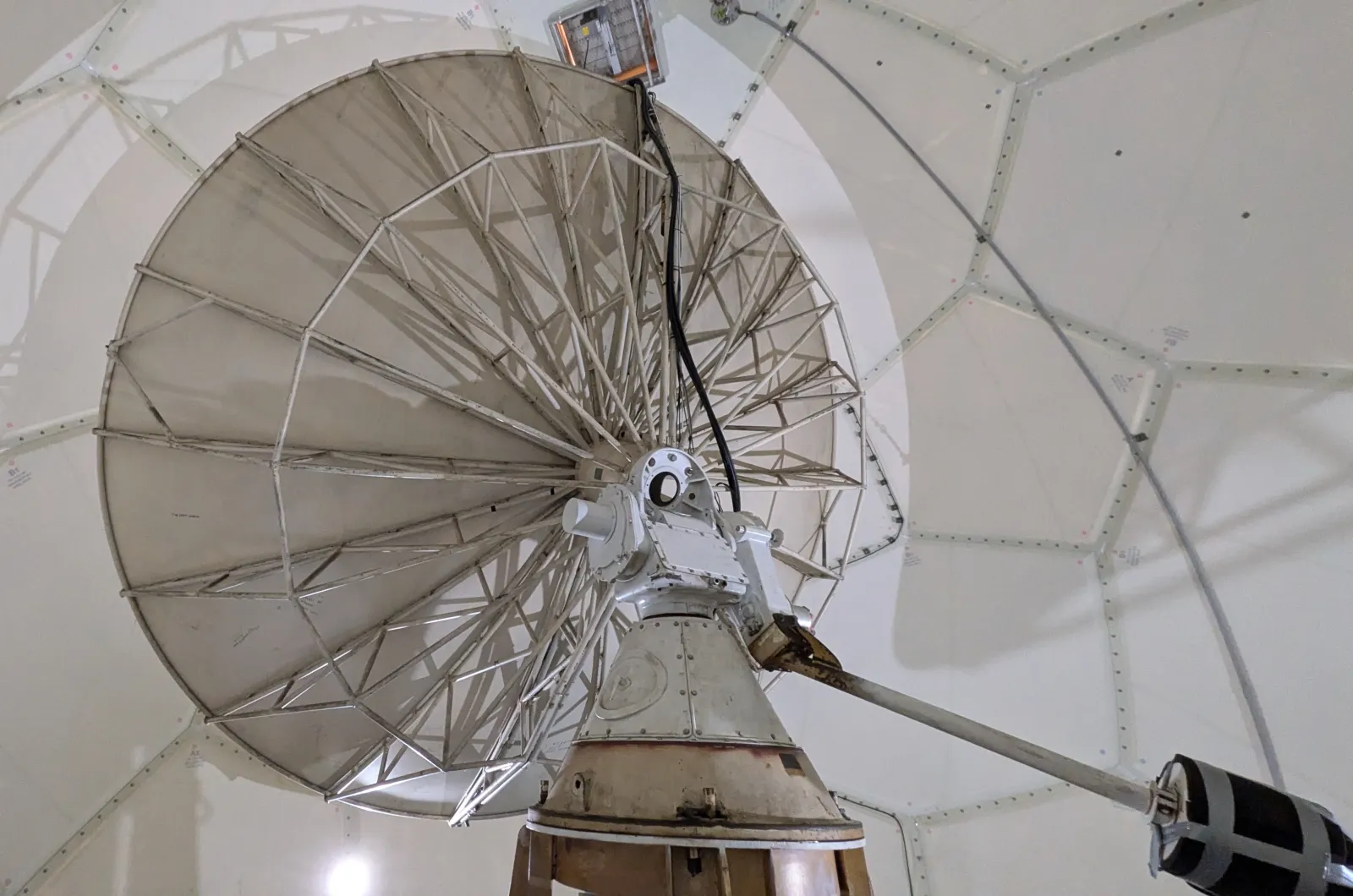
Yes, which is why every radome, antenna cover and 5G enclosure that needs a composite skin uses glass or quartz rather than carbon. AGY lists E-glass at a dielectric constant of 6.1 and a loss tangent of 0.004 at 10 GHz, and its low-dielectric L-glass, L2-glass and L-HDI grades at 4.8, 4.4 and 5.2 [company] [S10]. S-2 Glass carries a 20% lower dielectric constant than E-glass, which AGY markets for radomes [company] [S9]. Carbon fiber, being conductive, reflects and absorbs the signal; it is used for shielding, not windows.
Two specification details matter. First, ask for dielectric constant and loss tangent at the operating frequency, not the 1 MHz value common on glass datasheets: Jushi lists its E, E6, E7, E8 and E9 glasses at dielectric constants of 6.7 to 7.1 at 1 MHz, a different measurement from AGY's 10 GHz values [company] [S15] [S16]. Second, specify the resin, because the laminate's dielectric loss depends on both constituents. China's glass fiber association reports that low-dielectric and low-expansion electronic glass became a main profit driver in 2025, so low-Dk yarn is now available from Chinese suppliers as well as from AGY [statistic] [S27].
↔ Scroll horizontally to see the full chart and data table.
Source: AGY L-Glass product information. Carbon fiber is not shown: it is an electrical conductor (about 1.6 × 10⁻³ Ω·cm for T700S) and is not used in RF windows.
View the chart data and evidence
| Series | Category | Value | Unit | Evidence / value basis | Reported range | Point note |
|---|---|---|---|---|---|---|
| — | E-glass | 6.1 | Not specified | Company data | — | — |
| — | L-HDI glass | 5.2 | Not specified | Company data | — | — |
| — | L-glass | 4.8 | Not specified | Company data | — | — |
| — | L2-glass | 4.4 | Not specified | Company data | — | — |
7. Carbon-glass hybrids: wind spar caps, pultruded profiles and where mixing pays
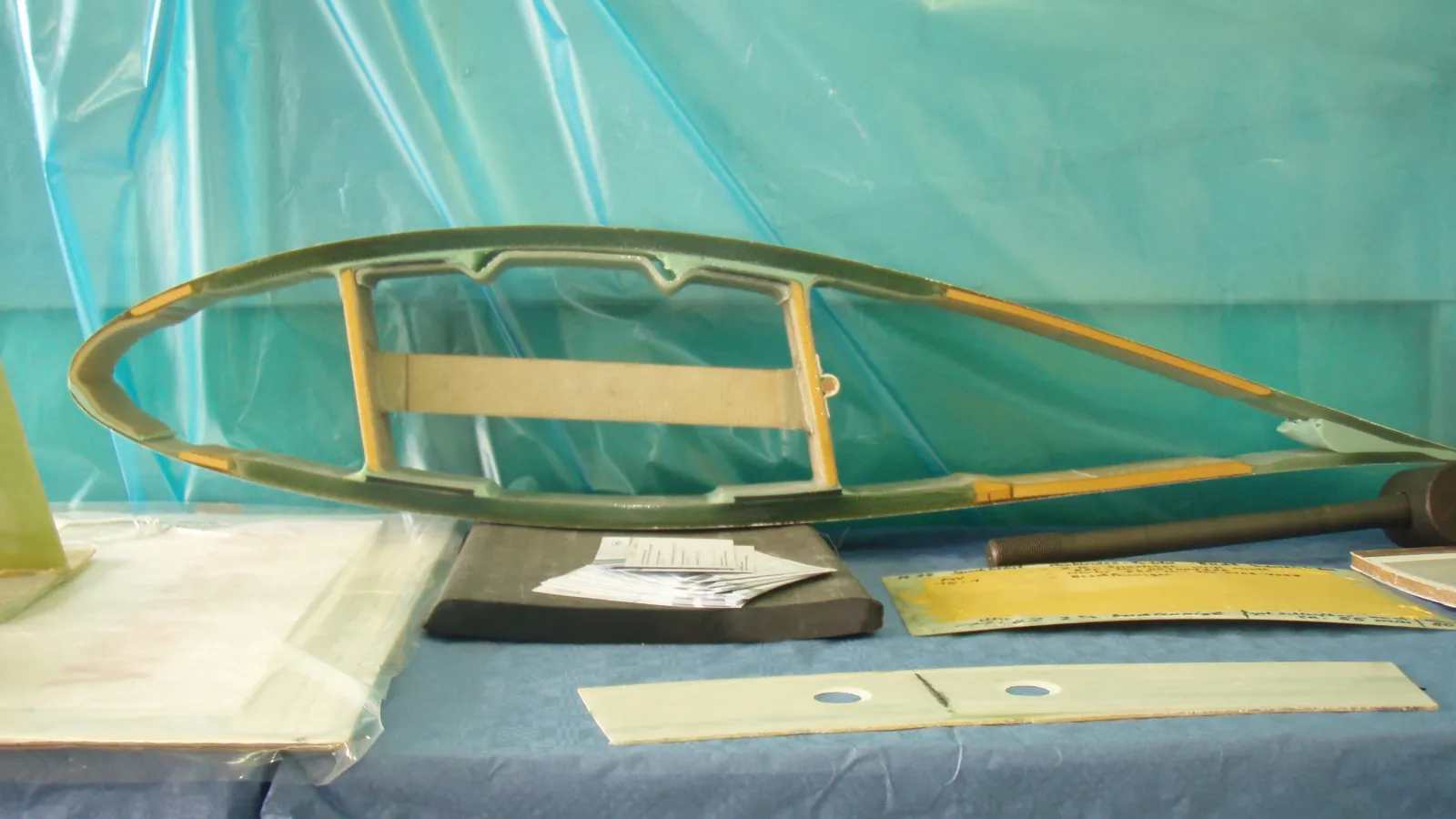
Hybrids make sense when stiffness governs only part of a part. Wind blades are the clearest case: China's composites association says blades below 80 m are designed mainly in glass, blades of 80–120 m increasingly use carbon-glass hybrid spar caps, and blades above 120 m use pure carbon; it cites hybrid pultruded plates with carbon-to-glass volume ratios of 1:2 and 2:3, and adds that ultra-high-modulus glass has reached about 90% of its theoretical modulus [statistic] [S19]. Wind blades already consume 20–25% of China's glass fiber capacity by the same source [statistic] [S19].
The economics come from the ORNL and Sandia model. Against an infused glass spar cap, a pultruded glass cap cut blade mass by 6–9% and a pultruded heavy-tow carbon cap by 30–31%; pultrusion lifts fiber volume from 0.57 to 0.68 and the glass plank's characteristic modulus from 42.8 to 51.1 GPa, while the carbon plank reaches 157.6 GPa [peer-reviewed] [S17]. The same study found pultruded glass the lower-cost spar cap for strength-driven, high-wind designs and heavy-tow carbon the lowest for stiffness- and fatigue-driven designs [peer-reviewed] [S17].
In pultruded profiles the logic is the same at smaller scale: put carbon rovings in the flanges or the outer layers of a beam, where bending stiffness is set, and glass in the web and the mats that carry shear and bolt bearing. A hybrid is not free: the two fibers fail at different strains, so the carbon fails first under overload, and the laminate must be designed and tested as a hybrid rather than interpolated between datasheets. For a buyer the hybrid ratio, the position of each fiber and the test report on the actual laminate belong in the specification.
↔ Scroll horizontally to see the full diagram.
| Spar cap | Fiber volume | Modulus (GPa) | Tensile / compressive strength (MPa) | Density (kg/m³) | Part cost (USD/kg) | Blade mass vs infused glass |
|---|---|---|---|---|---|---|
| Infused E-glass | 0.57 | 42.8 | 1,002 / 637 | 1,980 | 1.92 | baseline |
| Pultruded E-glass | 0.68 | 51.1 | 1,252 / 796 | 2,125 | 2.65 | −6% to −9% |
| Pultruded baseline carbon | 0.68 | 157.6 | 2,236 / 1,528 | 1,620 | 17.38 | slightly more than −30% |
| Pultruded heavy-tow textile carbon | 0.68 | 160.6 | 1,357 / 1,183 | 1,580 | 9.44 | −30% to −31% |
Source: Ennis, Das and Norris, Composites Part B 265 (2023), Table 2 and blade results; US cost basis.
8. Sourcing carbon fiber and fiberglass from China: supply on each side
China is the world's largest producer of both fibers, but the two industries are at different stages. On the glass side, China made 8.43 million tonnes of yarn in 2025, and three groups, Jushi, Taishan and CPIC, hold about 70% of capacity [statistic] [S27]. On the carbon side, Sail Carbon Fiber's survey, quoted in Guangwei's annual report, counts 171,080 tonnes per year of Chinese operating capacity in 2025, 52.5% of the world, Chinese demand of 132,027 tonnes, up 57.1%, and a domestic share of the Chinese market of about 86% [survey] [S25]. The two series measure different things, yarn output against fiber capacity and demand, and are not comparable tonne for tonne.
Chinese carbon producers publish grade maps against Toray. Guangwei lists TZ300 as the T300 equivalent (national designation GQ3522), TZ700S as T700S (GQ4522), TZ800S as T800S (QZ5526), TZ1100G as T1100G (QZ6526) and TZ40J to TZ65J as M40J to M65J [company] [S26]; the national designations come from GB/T 26752-2020, the Chinese standard for PAN-based carbon fiber, with multifilament tensile testing under GB/T 3362-2017 [official] [S28]. Zhongfu Shenying sells SYT45 (T700 class) to SYT70 (T1100 class) from 29,000 tonnes per year of capacity at end-2025, rising to 38,000 tonnes by mid-2026 [company] [S23] [S24].
Trade treatment differs too. In the United States carbon fiber (HTS 6815.11) has a zero MFN rate but sits on the Section 301 list at 25% and carries the 12.5% China surcharge, while glass roving pays 4.8% MFN plus the same two additional duties [official] [S29] [S30]. In the EU, Chinese glass roving and mat carry 17.2–23.0% anti-dumping duty [official] [S31], while no EU anti-dumping measure applies to Chinese carbon fiber at the cut-off. That asymmetry can move a cost comparison for an EU buyer by several percentage points of landed cost.
| Item | Glass fiber | Carbon fiber |
|---|---|---|
| National volume | 8.43 Mt yarn output (2025) | 171,080 t/yr operating capacity; 132,027 t demand (2025) |
| Leading producers | Jushi 3.20 Mt; Taishan 1.37 Mt; CPIC 1.18 Mt sold | Zhongfu Shenying 25,054 t sold; Guangwei, Jilin, Hengshen and others |
| Grades to ask for | E-CR (E6), E7/E8/E9 high modulus, low-Dk electronic yarn | T300 to T1100 equivalents; M40J to M65J high modulus; 24K–50K large tow |
| Chinese standard | GB/T 18369-2022 roving; GB/T 7690 and GB/T 9914 test methods | GB/T 26752-2020 PAN carbon fiber; GB/T 3362-2017 strand tension; GB/T 3354-2014 laminate tension |
| US duty (HTS 2026) | 7019.12: 4.8% + 25% + 12.5% | 6815.11: 0% + 25% + 12.5% |
| EU trade defense | AD 17.2–23.0% plus CVD 5.8–10.2% (roving, mat) | none at cut-off |
| GetFRP profiles | Jushi, Taishan, CPIC | Zhongfu Shenying, HRC |
Source: CGFIA via China Jushi 2025 annual report; Sail via Guangwei 2025 annual report; Zhongfu Shenying filings; Guangwei product page; SAMR registry; USITC; EU Regulation 2025/2337.
9. When to use carbon fiber vs fiberglass: a decision framework
Start from what limits the part, not from the material. If deflection, natural frequency or weight at a fixed stiffness sets the size, carbon's four-to-five-fold specific stiffness usually pays even at five times the cost per unit stiffness, because the part also shrinks. If strength at low cost, impact, electrical insulation or RF transparency sets the size, glass wins outright. If only part of the section is stiffness-critical, a hybrid places carbon there and glass elsewhere.
Three checks catch most wrong choices. First, compute the stiffness-normalized cost with your own quotes, as in Table 3, rather than comparing per-kilogram prices. Second, check every metal interface for galvanic isolation if carbon is chosen. Third, check the thermal expansion mismatch at bonded joints, since a UD carbon laminate expands by only 0.3–0.7 × 10⁻⁶/K and most structural metals expand far more.
↔ Scroll horizontally to see the full diagram.
| Governing requirement | Favors | Why, in numbers |
|---|---|---|
| Deflection or stiffness at minimum weight | Carbon | Specific modulus about 128 vs 28–36 GPa·cm³/g |
| Lowest cost for a strength requirement | Glass | Carbon is about 23× per kg and about 7.6× per unit of strength |
| Fatigue in tension-dominated parts | Carbon, or high-performance glass | E-CR UD laminate at 26% of static strength after 10⁶ reversed cycles |
| Impact, overload, abuse | Glass (S-2 for armor) | Strain to failure 4.0–5.5% vs 1.5–2.1% |
| Electrical insulation, galvanic safety | Glass | Insulator vs 1.6 × 10⁻³ Ω·cm |
| Radar or RF transparency | Glass or quartz | Dk 4.4–6.1 at 10 GHz; carbon is opaque |
| Dimensional stability over temperature | Carbon | UD CTE 0.3–0.7 vs 11 × 10⁻⁶/K |
| Long blades, long beams with mixed loads | Hybrid | Carbon:glass plate ratios of 1:2 and 2:3 in use |
Source: GetFRP synthesis of the data in Sections 1 to 8.
10. RFQ checklist for carbon fiber or fiberglass reinforcement from China
Write the RFQ around the property that governs the design and the evidence that will prove it. The list below applies to fiber, fabric, prepreg or a finished laminate; drop the items that do not apply to the product being bought.
- 1. Fiber identity: for carbon, the grade and its Toray equivalent (for example TZ700S / T700S class, GB/T 26752 designation GQ4522), filament count (12K, 24K, 48K) and sizing type and amount (for example 1.0% epoxy-compatible); for glass, glass type (E-CR, E8) and the manufacturer's sizing code.
- 2. Fiber properties per lot: impregnated-strand tensile strength and modulus per GB/T 3362-2017 or ISO 10618 for carbon (for example at least 4,900 MPa and 230 GPa for T700S class) and ASTM D2343 for glass (at least 2,200 MPa and 80 GPa for E-CR).
- 3. Laminate evidence: UD tension per ASTM D3039 or GB/T 3354-2014 and compression at a stated fiber volume (55–60%) and resin, plus interlaminar shear; for hybrids, the actual hybrid layup, not each fiber separately.
- 4. Fiber volume or weight fraction by burn-off or digestion, with the target band stated (for example 60 ± 3% by volume for carbon prepreg laminates).
- 5. Electrical and RF requirements: isolation ply schedule for carbon parts touching metal; dielectric constant and loss tangent at the operating frequency (for example 10 GHz), after humidity conditioning, for glass radome laminates.
- 6. Thermal requirements: CTE of the laminate in the joint direction where the part is bonded to metal, and the service temperature range.
- 7. Fatigue or impact data where they govern: S-N data at the stated R-ratio for fatigue-loaded parts, compression after impact or open-hole compression for carbon structures.
- 8. Traceability: producer, plant and lot on every certificate; written notice of any change of fiber grade, sizing or plant.
- 9. Commercial basis: price per kg and price per unit stiffness on the same Incoterm, HS code (6815.11 carbon fiber; 7019.12 glass roving) and destination duty stack.
How to read the evidence tags
Company: datasheets, annual reports and company statements. Statistic: association, price-agency and modeled research data. Survey: industry survey estimates. Official: regulations, tariff schedules, standards and regulator guidance. Peer-reviewed: journal papers. Estimate: GetFRP calculation with inputs shown. Fiber-level and laminate-level values are never mixed in one comparison.
Frequently asked questions
Is carbon fiber stronger than fiberglass?
Yes. T700S carbon fiber has a strand strength of 4,900 MPa against 2,200–2,500 MPa for E-CR glass roving, and a UD carbon/epoxy laminate reaches about 2,000 MPa against 1,100 MPa for UD glass/epoxy. Per unit weight carbon is about three times stronger. Glass stretches further before breaking: about 4% against 2%.
Is carbon fiber stiffer than fiberglass?
About three times stiffer: 230 GPa for standard-modulus carbon against 72–81 GPa for E-glass and E-CR glass, and 130 against 43 GPa in UD epoxy laminates. Because carbon is also 30% lighter, its stiffness per unit weight is about 4.5 times that of E-glass.
How much more expensive is carbon fiber than fiberglass?
In China in autumn 2026 about 23 times per kilogram: RMB 85–86/kg for the carbon fiber market average against RMB 3.7–3.8/kg for E-glass roving. Per unit of stiffness the premium falls to about 5 times, and with low-cost heavy-tow carbon in pultruded parts it can approach parity.
Which is lighter, carbon fiber or fiberglass?
Carbon fiber, at 1.76–1.80 g/cm³ against 2.49–2.63 g/cm³ for glass. For equal stiffness a carbon part can weigh far less; the ORNL and Sandia model found pultruded carbon spar caps cut wind blade mass by 30–31% against infused glass.
Does carbon fiber block radio and radar signals?
Yes. Carbon fiber is electrically conductive (about 1.6 × 10⁻³ Ω·cm) and reflects RF energy, so radomes, antenna covers and 5G enclosures use glass or quartz. E-glass has a dielectric constant of 6.1 at 10 GHz and low-dielectric glasses 4.4–5.2.
Can carbon fiber be in contact with aluminum?
Only with isolation. Carbon acts as the noble electrode and corrodes aluminum in a wet joint. The FAA advises isolation layers, for example glass plies, between carbon laminates and aluminum, plus galvanic checks on fasteners.
Is fiberglass more impact resistant than carbon fiber?
Generally yes. E-glass fails at about 4% strain and S-2 Glass at 5.5%, against 1.5–2.1% for carbon, so glass laminates absorb more energy before fiber fracture. S-2 Glass is used in armor for that reason; carbon designs rely on notched and post-impact allowables.
When does a carbon-glass hybrid make sense?
When stiffness governs only part of the section. In wind blades, China's composites association reports hybrid spar caps for 80–120 m blades, with carbon-to-glass volume ratios of 1:2 and 2:3, glass below 80 m and pure carbon above 120 m.
Sources and scope
Figures were cross-checked against primary documents where available; secondary citations are marked in each scope note. Company figures are reported as disclosed by the companies themselves. This note is an independent market assessment and not investment advice.
- [S1]Toray Composite Materials America, TORAYCA T700S data sheet
4,900 MPa, 230 GPa, 2.1%, 1.80 g/cm³, 7 µm; CTE −0.38; resistivity 1.6 × 10⁻³ Ω·cm; sizing types; 60% Vf epoxy laminate properties.
- [S2]Toray Composite Materials America, TORAYCA T300 data sheet
3,530 MPa, 230 GPa, 1.5%, 1.76 g/cm³; CTE −0.41; resistivity 1.7 × 10⁻³ Ω·cm; laminate 1,820 MPa and 140 GPa at 60% Vf.
- [S3]Toray Composite Materials America, TORAYCA T800S data sheet
5,880 MPa, 294 GPa, 2.0%, 1.80 g/cm³, 5 µm; CTE −0.4; resistivity 1.3 × 10⁻³ Ω·cm; laminate 3,290 MPa, 163 GPa, 1,490 MPa compression.
- [S4]Toray Composite Materials America, TORAYCA carbon fiber property card
Nominal strength, modulus and density from T300 to T1100G and M35J to M60J; impregnated-strand basis.
- [S5]Hexcel, HexTow AS4 carbon fiber product data sheet
4,501 MPa, 231 GPa, 1.8%, 1.79 g/cm³; AS4/8552 laminate 2,137 MPa, 135 GPa, 1,530 MPa compression.
- [S6]Hexcel, HexTow IM7 carbon fiber product data sheet
5,670 MPa, 276 GPa, 1.8%, 1.78 g/cm³; IM7/8552 laminate 2,723 MPa, 164 GPa, open-hole tension 428 MPa and compression 337 MPa.
- [S7]Hexcel, HexForce technical fabrics handbook
US-unit fiber table: E-glass 500 ksi, 10.5 Msi, 4%; S-2 Glass 665 ksi, 12.5 Msi, 5.5%, 0.090 lb/in³, CTE 0.90 × 10⁻⁶/°F; converted to SI by GetFRP. Metric table not used because of internal inconsistencies.
- [S8]Hexcel, Prepreg Technology
Typical mechanical and thermal values for E-glass, aramid, HS and IM carbon epoxy laminates, UD and fabric, including CTE.
- [S9]AGY, S2 Glass fiber rovings product information (2025)
30% higher strength and 15% higher modulus vs E-glass at the same Vf; 20% lower dielectric constant; impact and damage tolerance claims; applications.
- [S10]AGY, L-Glass product information
E-glass: Dk 6.1, tan δ 0.004 at 10 GHz, 2.54 g/cm³, CTE 5.4 × 10⁻⁶/°C, 72 GPa; L, L2 and L-HDI glass Dk 4.8, 4.4, 5.2.
- [S11]3B, SE 2020 direct roving for epoxy resins datasheet
E-CR epoxy UD laminate at Vf 55%: 980 MPa, 44 GPa, 61 MPa transverse; fatigue 255 MPa at 10⁶ cycles, R = −1.
- [S12]3B, SE 3030 direct roving datasheet
UD laminate at Vf 60% in polyester and epoxy: 1,200 MPa, 49 GPa; polyester fatigue 310 MPa and 0.64% at 10⁶ cycles, R = 0.1.
- [S13]3B, HiPer-tex W 2020 rovings datasheet
R-glass strand 2,700–2,900 MPa, 86–89 GPa; UD laminate 1,280 MPa, 48 GPa, 900 MPa compression at Vf 56%; claim of up to ten times E-glass fatigue life.
- [S14]3B, SE 1010 direct roving datasheet
E-CR roving: 2,200–2,500 MPa and 81 GPa strand (ASTM D2343), 2.62 g/cm³, 17–24 µm.
- [S15]China Jushi, E8 high-modulus glass fiber brochure
E8 strand 3,100–3,500 MPa and 95–98 GPa; density 2.62–2.63; dielectric constant at 1 MHz.
- [S16]China Jushi, E9 ultra-high-modulus glass fiber brochure
E7, E8, E9 UD epoxy laminates at Vf 55% (49–50, 51–52, 54–55 GPa); 1 MHz dielectric constants; acid retention data.
- [S17]Ennis, Das and Norris, Economic competitiveness of pultruded fiber composites for wind turbine applications, Composites Part B 265 (2023), OSTI full text
Fiber and resin costs; plank and part costs; 95/95 characteristic properties; cost-specific modulus; blade mass reductions of 6–9% (pultruded glass) and 30–31% (textile carbon). Peer-reviewed model, US basis.
- [S18]Sandia National Laboratories, Blade System Design Studies Volume I: Composite Technologies for Large Wind Turbine Blades (SAND2002-1879)
Hybrid carbon-glass blades identified as a promising combination of cost, weight, stiffness and fatigue; carbon-dominated laminate fatigue and ply-drop caveat.
- [S19]China Composites Industry Association, composite wind blade technology and market analysis (April 2024)
Glass below 80 m, hybrid at 80–120 m, carbon above 120 m; hybrid plate ratios 1:2 and 2:3; carbon priced 8–15× glass; wind blades 20–25% of China's glass fiber capacity.
- [S20]US Federal Aviation Administration, AC 20-107B Composite Aircraft Structure, with change 1
Isolation layers between composite and metal, e.g. glass plies between carbon and aluminum; galvanic corrosion in fastener qualification.
- [S21]Baiinfo, China carbon fiber market channel
Domestic carbon fiber market average RMB 85.5/kg on 3 November 2026, all grades. Price-agency data; grade mix not disclosed.
- [S22]NetEase industry review of the glass fiber cycle citing Sublime China Information (13 October 2026)
2400 tex E-glass direct roving national average at end-June and mid-September 2026. Secondary summary of price-agency data.
- [S23]Zhongfu Shenying Carbon Fiber, 2025 annual report (SSE 688295)
Carbon fiber revenue RMB 2.169 bn; 25,054 t sold; capacity 29,000 t/yr with 31,000 t under construction; SYT45 to SYT70 grade range.
- [S24]Zhongfu Shenying Carbon Fiber, 2026 interim report
Capacity of 38,000 t/yr at end of H1 2026 including 9,000 t released at Lianyungang.
- [S25]Weihai Guangwei Composites, 2025 annual report (SZSE 300699)
Quotes Sail's 2025 survey: China operating capacity 171,080 t (52.5% of world), global demand 224,510 t, China demand 132,027 t, domestic share 86%.
- [S26]Weihai Guangwei Composites, carbon fiber and fabrics product page
Grade table mapping TZ grades to GB/T 26752 designations and Toray equivalents from T300 to M65J.
- [S27]China Jushi Co., Ltd., 2025 annual report (SSE 600176)
CGFIA 2025 glass fiber yarn output 8.43 Mt; concentration of Chinese capacity.
- [S28]SAMR national standards registry: search results for PAN-based carbon fiber
GB/T 26752-2020 PAN-based carbon fiber, in force 1 February 2021; related entries GB/T 3362-2017 and GB/T 3354-2014 confirmed in the same registry.
- [S29]USITC, Harmonized Tariff Schedule search, heading 6815
Carbon fibers 6815.11.00 at a free general rate.
- [S30]USITC, HTSUS chapter 99, 2026 revision 22
US note 20(f) listing 6815.11 and 7019 lines under heading 9903.88.03 (25%); heading 9903.05.31 adding 12.5% on products of China.
- [S31]Commission Implementing Regulation (EU) 2025/2337, anti-dumping duty on continuous filament glass fibre products from China
AD rates of 17.2–23.0% on Chinese rovings, chopped strands and mats from 26 November 2025.
Image provenance and usage terms appear in each caption; see image credits. Submit a source correction.