1. A substantial supply chain without a defensible pipe-only headline number
The useful starting point for China's FRP pipe industry is the project package: which fluid must move, through which geometry, under which loads, and who accepts the installed system? This research did not establish a reliable public national total for FRP pipe revenue or tonnage. Glass fiber yarn, all reinforced-plastic products, pipes plus tanks, and water infrastructure investment describe different markets. Adding or relabeling those figures would obscure the purchasing decision. This report therefore uses verified demand indicators and named manufacturing examples, with no invented pipe-market share or forecast CAGR.
Completed Chinese water-conservancy construction investment was RMB 1,284.8 billion in 2025, compared with RMB 1,352.9 billion in 2024. The 2025 ministerial report also records 47,563 projects. The investment series fell about 5.0% between those two years, although it remained large; it is not an uninterrupted growth story. These totals include extensive non-pipe expenditure and multiple competing construction materials. They establish the scale of the surrounding project economy, not the value of orders available to fiberglass manufacturers. [S1][S2]
GetFRP's interpretation is that market access depends on specification position and execution capability as much as on factory capacity. An exporter should distinguish an approved design awaiting purchase, a tender still comparing materials, and a policy announcement with no released bill of quantities. Those are different stages of demand. A practical opportunity register records owner, design consultant, EPC contractor, service conditions, procurement stage and qualifying evidence. Only confirmed pipe quantities should enter a sales forecast; broad infrastructure budgets belong in the background analysis.
↔ Scroll horizontally to see the full chart and data table.
Source: [S1][S2]. Completed investment, not FRP pipe spending. Original figures in RMB 100 million converted to billions by dividing by 10. Change: 1284.8 / 1352.9 - 1 = -5.03%.
View the chart data and evidence
| Series | Category | Value | Unit | Evidence / value basis | Reported range | Point note |
|---|---|---|---|---|---|---|
| — | 2024 | 1352.9 | RMB billion | Official source | — | — |
| — | 2025 | 1284.8 | RMB billion | Official source | — | — |
2. Water networks, industrial seawater and process plants create different opportunities
China's 2025 national seawater report records 167 desalination facilities with combined capacity of 3,076,805 tonnes per day, up 221,283 tonnes per day from 2024. Its national statistics exclude Hong Kong, Macao and Taiwan. A July 2026 interministerial action plan targets at least 4.5 million tonnes per day by 2030. The first figure is installed capacity; the second is a policy target. Neither establishes future utilization, financed construction or an FRP material allocation. [S3][S4] Shandong, Zhejiang, Hebei and Tianjin together account for 88.9% of 2025 capacity, calculated from the report's provincial figures. This concentration helps prioritize coastal project tracking; it does not reveal the pipe material chosen. [S3]
For a pipe supplier, a desalination plant must be separated into line classes. Intake and outfall, low-pressure transfer, cooling water, chemical dosing and the high-pressure membrane section have different pressure, chemical, joining and inspection requirements. Treating the whole facility as one addressable FRP package would overstate the opportunity. GetFRP recommends requesting the piping material specification and line list before discussing a plant-level contract value. Identify where an owner has already approved a composite system and where an alternative-material submission remains necessary.
Municipal rehabilitation has a different trigger. A 2024 notice from the housing ministry and other ministries sets a 2027 urban domestic-sewage centralized collection target of at least 73%, alongside network investigation and renewal measures. It does not mandate FRP. [S5] The commercial implication is to compete on the particular installation problem: access, service interruption, corrosion exposure, excavation, joints and inspection. A favorable material description alone will not resolve a congested urban route, uncertain existing connections or an owner who requires continuity of service during construction.
Industrial chemical projects create another segment, where medium composition and shutdown consequences can dominate the initial invoice. The procurement team needs the normal process envelope and the upset envelope, including cleaning and flushing. A project can need several pipe constructions within the same site. Our market judgment is that the strongest bids make those boundaries explicit, quantify the supplier's included services and identify responsibility for each interface. A broad claim that one resin or one factory can serve every line class should lead to more detailed review.
↔ Scroll horizontally to see the full chart and data table.
Source: [S3]. 2024 = (3,076,805 - 221,283) / 1,000,000; reconstructed from the same report's stated increase. Capacity is a demand indicator, not FRP pipe sales or annual water production.
View the chart data and evidence
| Series | Category | Value | Unit | Evidence / value basis | Reported range | Point note |
|---|---|---|---|---|---|---|
| — | 2024 derived | 2.855522 | million tonnes/day | GetFRP estimate | — | — |
| — | 2025 reported | 3.076805 | million tonnes/day | GetFRP estimate | — | — |
| Segment | Buying decision | Evidence to obtain |
|---|---|---|
| Water transmission / drainage | Hydraulic and civil-system acceptance | Route, soil, loads, hydraulic duty, joints and installation basis |
| Desalination / cooling water | Line-class and material approval | Service-specific pressure, seawater chemistry, vacuum and interfaces |
| Chemical processing | Compatibility and shutdown exposure | Full medium composition, upset conditions, liner and repair method |
| Marine / offshore | Owner and applicable approval requirements | System qualification, fire/electrostatic assessment where relevant, certificate scope |
Source: GetFRP segmentation and procurement analysis; application boundaries informed by [S10][S11][S13].
3. Chinese producer capabilities are diverse; compare documented product families
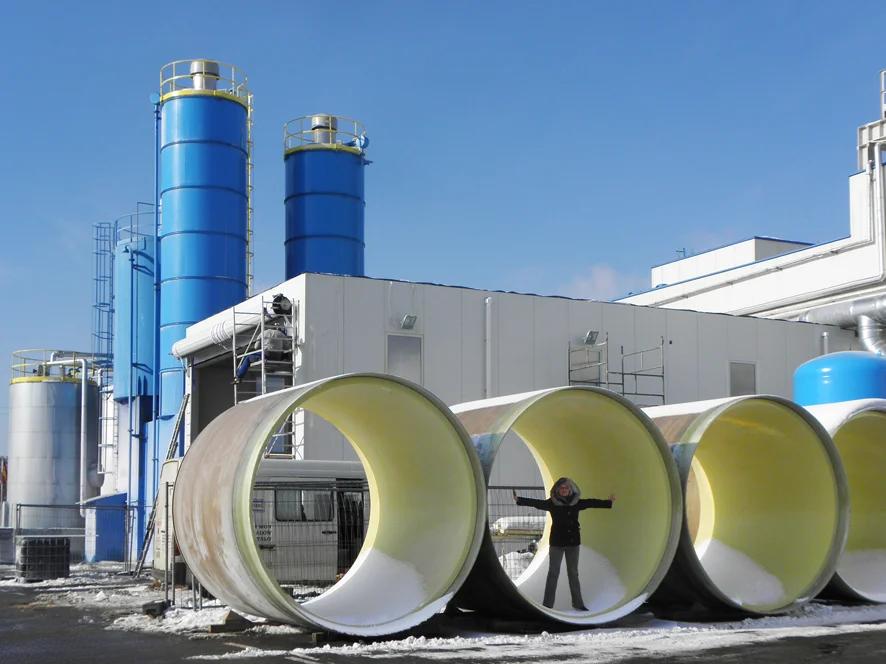
Public producer evidence demonstrates different routes into the market. Zhejiang Huafeng New Material publishes continuously wound GRP mortar pipe in a declared DN300–4000 range. Lianyungang's science and technology bureau reported Zhongfu Lianzhong's DN5000 production and batch delivery on 27 March 2025. Suzhou Jiumei's official portfolio separates marine/offshore piping from land high-pressure applications. These are examples of manufacturing and application scope, not a national ranking, an audited capacity census or an endorsement of every listed product. [S6][S7][S8]
The large-diameter milestone deserves careful interpretation. Capability to manufacture a large shell does not establish every combination of pressure, stiffness, joint type and service environment at that diameter. ISO 23856's published scope extends to DN4000; a DN5000 procurement therefore needs an explicitly accepted design and qualification basis rather than an assumption that the standard's stated diameter scope automatically covers it. [S10] Ask the manufacturer to identify the exact product family, supporting reports and project acceptance route before comparing the price with a smaller catalogue product.
GetFRP recommends evaluating the proposed plant and the actual subcontracting chain. Separate straight-pipe winding, fitting fabrication, machining, coupling manufacture and field installation support. An attractive project photograph cannot show which company designed the laminate or who made the fittings. Request an organization chart for the order, identify outsourced activities and agree how material or process changes are approved. This also makes the commercial comparison fairer: a supplier offering only straight pipe should not be ranked against a bidder responsible for engineering, fittings and commissioning without adjusting the scope.
| Producer | Verified public signal | What remains to verify |
|---|---|---|
| Zhejiang Huafeng New Material | Official continuous-winding GRP mortar-pipe page; declared DN300–4000 [S6] | Available diameter / pressure / stiffness combinations and plant-specific qualification |
| Zhongfu Lianzhong | Local government reports DN5000 batch delivery, March 2025 [S7] | Applicable design basis, test evidence and comparable service references |
| Suzhou Jiumei | Official marine/offshore and land high-pressure product portfolios [S8] | Exact material system, valid approvals, joint qualification and included field services |
Source: [S6][S7][S8]. Manufacturer declarations and a dated government report; not market-share or capacity rankings.
4. GRP, GRE and dual laminate describe different construction decisions
FRP is a broad material family; GRP identifies glass reinforcement, while GRE identifies a glass/epoxy construction. A sand-filled or polymer-mortar pipe adds another structural distinction. Flowtite's technical guide describes glass reinforcement, resin and silica sand arranged in a composite wall, with the sand-containing core contributing thickness and stiffness. [S18] It follows that total wall thickness or shipping weight cannot, on its own, rank pressure capacity. The buyer needs to understand what carries load and which layers provide the service barrier.
Future Pipe's Wavistrong engineering guide describes epoxy-based wound systems and distinguishes joints that transfer axial force from non-tensile-resistant sealing joints. [S19] That distinction is more useful than assuming that all GRE is one pressure class. For comparison, Versteden's DucoVer catalogue describes thermoplastic liners with FRP structural backing. [S20] Such a dual laminate has a separate liner and joining problem; it is not simply another name for a resin-rich thermoset corrosion barrier. Neither a resin label nor a familiar acronym establishes interchangeable performance.
Our procurement recommendation is to request a controlled construction description for each line class: reinforcement, matrix, filler if present, liner or corrosion barrier, exterior protection and the transitions at fittings. Ask whether the proposed evidence covers the same construction. If the supplier offers a lower-cost wall, the comparison must explain which layer changed and what evidence supports the revised design. A change in filler distribution, reinforcement orientation or resin system should be reviewed as a technical change, with commercial savings evaluated only after acceptance.
| Construction | Typical sourcing question | Avoid this shortcut |
|---|---|---|
| GRP mortar / sand-filled water pipe | Pressure, ring stiffness, liner, coupling and burial basis | Thicker wall means higher pressure capacity |
| GRE industrial piping | Qualified pressure-temperature envelope, axial loads and joint system | Epoxy alone defines the complete service rating |
| Thermoplastic / FRP dual laminate | Liner compatibility and weld quality plus structural backing and joint design | Chemical resistance of the liner proves the whole pipe system |
Source: [S18][S19][S20]; distinctions and purchasing interpretation by GetFRP.
5. Set a coherent standards hierarchy before accepting a quotation
The Chinese catalogue lists GB/T 21238-2016, covering glass-fiber-reinforced plastic mortar pipe, as current after its August 2024 review. It is a non-equivalent adoption of ISO 10639:2004. ISO 23856:2021 is the published water-supply, drainage and sewerage GRP standard replacing ISO 10639:2017 and ISO 10467:2018. Its scope concerns unsaturated-polyester-based systems, with vinyl ester included in that definition. The ISO catalogue shows a revision under development at this report's cut-off; that is not a newly published replacement edition. [S9][S10]
ISO 14692 serves a different system context. Part 1 defines its application and classification framework for GRP piping, including joints that restrain axial thrust; it is not limited to epoxy. Part 2 addresses qualification and manufacture, Part 3 system design, and Part 4 fabrication, installation and operation. [S11][S12][S13][S14] A supplier listing only 'ISO pipe' has not identified the applicable technical basis. Public catalogue abstracts establish scope; they do not replace the full standards needed for project design and contractual compliance.
GetFRP recommends an explicit precedence order covering the owner's specification, governing design basis, product standard, test methods and approved deviations. Resolve conflicting requirements before manufacture. Keep a compliance matrix with a report number or calculation against each requirement, rather than a page of unrelated logos. A test method tells a laboratory how to obtain a result; it does not necessarily supply the acceptance limit for the project. Similarly, an old certificate may be useful evidence without demonstrating that every requirement of a later contract edition is satisfied.
| Reference | Role | Procurement boundary |
|---|---|---|
| GB/T 21238-2016 [S9] | Chinese mortar-pipe product standard | Current; not identical to ISO 23856 |
| ISO 23856:2021 [S10] | UP-based GRP water / drainage / sewer systems | Published scope DN50–4000; includes VE within polyester definition |
| ISO 14692-1 to -4:2017 [S11][S12][S13][S14] | Application, qualification, system design and installation | Apply the series within its system scope; not a generic approval stamp |
| ASTM D2992-24 [S15] | Hydrostatic or pressure design-basis practice | Regression evidence; not just a short burst test |
| NSF/ANSI/CAN 61 [S16] | Drinking-water contact health effects | Does not establish structural pressure performance |
Source: Official issuer descriptions reviewed 8 November 2026. No claim that these references are mutually equivalent.
6. Pressure, ring stiffness and axial restraint are independent checks
A buried pipe is a structural system involving both pipe and ground. Flowtite's installation guidance distinguishes pressure loading from external soil and traffic effects, and emphasizes bedding, backfill placement and compaction. [S17] For purchasing, this means that pressure class and ring stiffness cannot substitute for one another. The calculation package must also address the relevant groundwater, vacuum, cover, live loads and installation conditions. An upgraded pipe class does not by itself demonstrate that the assumed civil conditions will actually be achieved on site.
Axial force is easy to underestimate when buyers focus on diameter and working pressure. Consider an explicitly illustrative closed end with actual internal diameter 1.2 m at static pressure 1.0 MPa. Pressure force is p × pi × D² / 4, giving about 1,131 kN. Doubling actual bore from 0.6 m to 1.2 m multiplies that force by four. The chart isolates this basic force contribution; it is not an anchor-block design, a joint allowable load or a pressure-rating recommendation.
A seal that prevents leakage is not automatically a restrained connection. The restrained or unrestrained system must be selected deliberately, with responsibility assigned for the resulting forces. For example, an ideal equal-bore 90-degree bend has a pressure-only resultant of square-root-of-two times pA, rather than pA; other geometries require their own analysis. Actual engineering must include the applicable transient and test conditions, thermal and support loads, momentum effects, ground resistance and safety provisions. The simple illustration is intended to expose missing scope in a quotation.
GetFRP's recommended review meeting brings the pipe manufacturer, piping stress designer, civil designer and installer together before the purchase order freezes interfaces. Confirm the actual bore, permitted movements, valve and equipment loads, restraint locations and access for joint assembly. Record who supplies each missing calculation. This prevents a commercially complete pipe order from reaching site with an unresolved civil or mechanical interface that is far more expensive to correct after delivery.
↔ Scroll horizontally to see the full diagram.
↔ Scroll horizontally to see the full chart and data table.
Source: GetFRP calculation: F = 1,000,000 × pi × internal diameter² / 4 / 1,000. Assumed actual internal diameters, not DN. Pressure contribution at a closed end only; excludes complete load combinations, structural capacity and anchor sizing. No product rating is implied.
View the chart data and evidence
| Series | Category | Value | Unit | Evidence / value basis | Reported range | Point note |
|---|---|---|---|---|---|---|
| — | 0.6 m ID | 282.7 | kN | GetFRP estimate | — | — |
| — | 1.2 m ID | 1131 | kN | GetFRP estimate | — | — |
| — | 2.0 m ID | 3141.6 | kN | GetFRP estimate | — | — |
7. Qualify the service barrier and drinking-water contact separately
A chemical-service inquiry needs more than a medium name. GetFRP recommends recording concentrations, contaminants, solids, cleaning fluids, normal and upset temperatures, exposure duration and any vacuum condition. Ask for a written material recommendation identifying the proposed resin or liner and the conditions it covers. If the recommendation excludes an upset or cleaning cycle, that exclusion should appear in the commercial deviation list. Otherwise the order may appear compliant while leaving the highest-consequence operating condition outside the accepted design.
The separation between chemical barrier and structural reinforcement is especially visible in dual laminate. Versteden describes a thermoplastic liner backed by structural FRP, with liner welding and structural joint work forming distinct operations. [S20] Our recommended review therefore asks who qualifies each joining procedure and how the completed interface is inspected. The material that contacts the fluid, the bond or interface behind it, and the load-carrying backing need to work together. A liner datasheet alone does not establish the behavior of a completed spool under the project's mechanical conditions.
Potable-water contact introduces another independent evidence requirement. NSF explains that NSF/ANSI 61 addresses health effects from substances imparted by components to drinking water; it does not establish their structural performance. [S16] For an export order, verify the destination's applicable approval route and the live listing for the exact product and manufacturing scope. Include seals, joining materials and other wetted components in the review. GetFRP recommends treating material substitutions after approval as controlled changes, because an apparently minor substitution can alter the evidence supporting the accepted system.
8. Long-term qualification, factory release and site acceptance answer different questions
ASTM D2992-24 establishes cyclic or static regression approaches for a hydrostatic or pressure design basis. Its public scope distinguishes the material and construction represented by the specimens, and the need to reevaluate changes. [S15] A short burst test or a successful shipment pressure test cannot establish the same information. The buyer should request the qualification basis applicable to the proposed product family and service environment, then identify whether the fittings and joints are represented rather than assuming that straight-pipe results cover the entire package.
Production control asks a different question: did the delivered order conform to that accepted construction? GetFRP recommends a lot map linking raw-material identity, approved formulation, manufacturing records, inspections, repairs and final marking. The order's inspection and test plan should identify witness and hold points early enough to be useful. Agree the treatment of nonconforming items before dispatch, including who approves repair procedures. A third-party visit is most valuable when it follows a specific evidence plan, rather than becoming a general tour of an otherwise impressive factory.
Installation acceptance then asks whether transport, storage, assembly and commissioning preserved the qualified design. The structure of ISO 14692 makes this division visible: qualification and manufacture sit in Part 2, while delivery through operation is addressed in Part 4. [S12][S14] GetFRP recommends three separate release records, each naming the accepted scope and responsible party. This division helps a buyer locate a later problem: a design-family issue, a production deviation and a field assembly defect require different evidence and different corrective action.
| Layer | Question | Suggested order record |
|---|---|---|
| Product qualification | Is the proposed family supported for this duty? | Design basis, qualification reports, scope and approved deviations |
| Production release | Does this shipment match the approved construction? | Lot traceability, inspection results, repair dispositions and marking |
| Installed-system acceptance | Was the delivered system assembled and commissioned correctly? | Joint records, civil inspections, test boundaries and signed handover |
Source: GetFRP evidence framework informed by [S12][S14][S15]; contract-specific acceptance criteria remain necessary.
9. The joint and installation package often decides export success
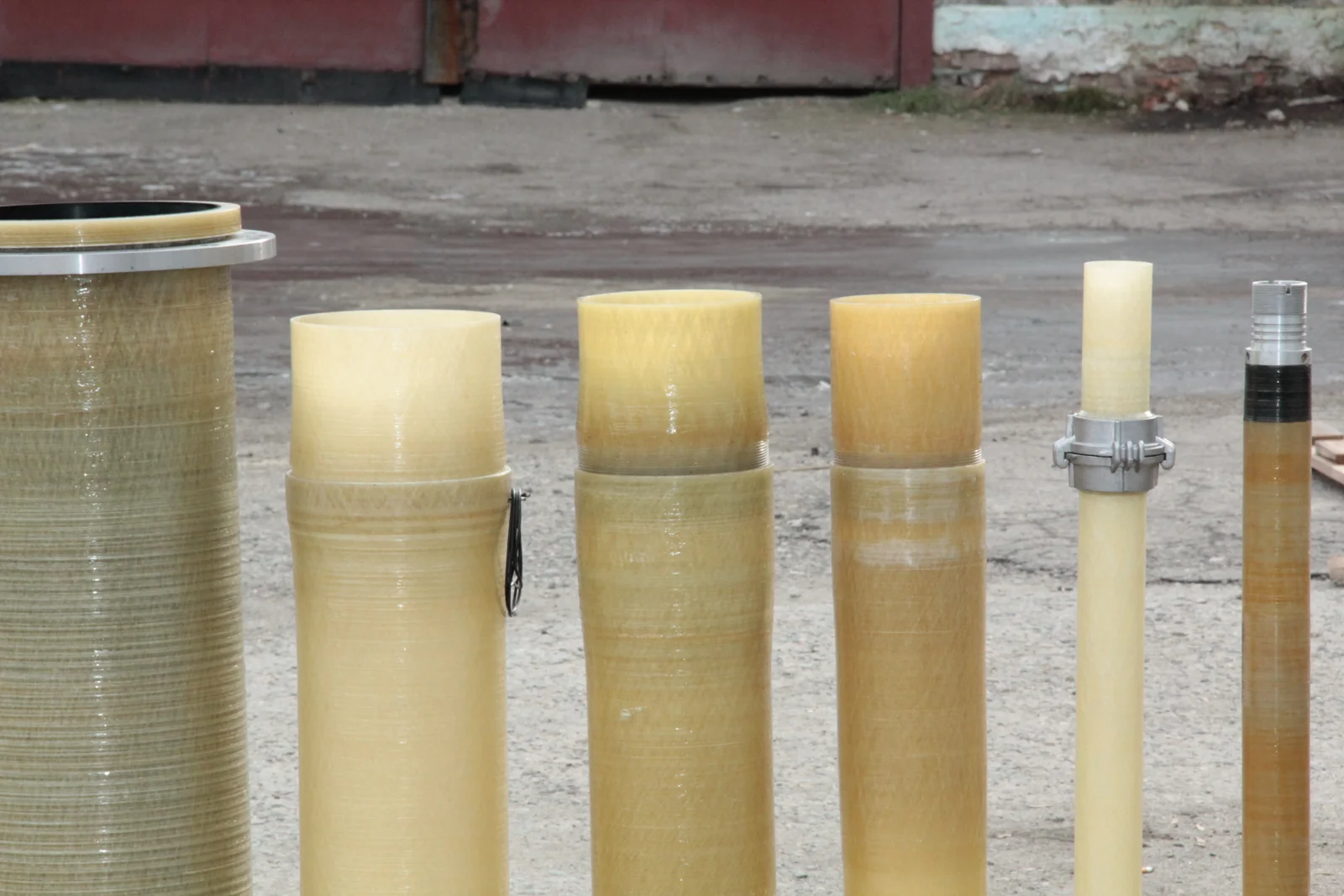
The same straight-pipe order can produce very different site work depending on the selected joint. Future Pipe publishes separate installation guidance for its adhesive, laminate, flange and mechanical joining arrangements, including personnel and procedure controls. [S21] The correct lesson is to obtain the approved instructions for the supplied system, not to apply one generic curing schedule to all GRE. GetFRP recommends a representative trial assembly before the main shipment whenever site experience with the proposed system is limited.
An export bid should name the party supplying joint consumables, tools, training and technical attendance, with quantities and storage requirements. Specify the languages and formats of installation instructions and the process for requesting field changes. Include transitions to valves, equipment and other pipe materials in the drawing review. A flange's nominal description does not alone resolve the full interface: the assembled arrangement, gasket, bolting and manufacturer requirements still need confirmation. An inexpensive coupling can become a schedule-critical item if its replacement or assembly tools are unavailable locally.
For buried systems, preserve records of the civil conditions assumed by the design. Flowtite's guide treats pipe-ground interaction and backfill execution as integral to performance. [S17] Our commercial recommendation is to allocate inspection responsibilities for the trench, foundation and placement stages before work starts, because those conditions become harder to verify after burial. Transport and storage also deserve an agreed method: support locations, lifting arrangements, protection of ends and couplings, shipment identification and arrival inspection. Avoid packing instructions based only on fitting the maximum number of pipes into a container.
10. Compare installed and lifetime costs with visible assumptions
GetFRP recommends two commercial comparisons. First compare equivalent delivered packages, including straight pipe, fittings, couplings, seals, spares, freight and agreed documentation. Then compare the installed systems, adding civil work, handling, assembly, inspection and commissioning. Keep taxes, currency dates and Incoterms visible. A price per tonne can reward unnecessary mass; a price per meter can conceal different bore or wall constructions. The meaningful denominator is the accepted system delivering the specified hydraulic duty, with scope and risk allocation held consistent.
A simple hypothetical model illustrates why the initial price does not settle the decision. Assume two technically acceptable systems over a 20-year accounting horizon. System A costs USD 300,000 installed at year zero and USD 3,000 annual maintenance; B costs USD 270,000 installed and USD 6,000 annual maintenance. These are invented scenario inputs, not Chinese market prices or observed supplier performance. At a 5% real discount rate, with maintenance held constant in real dollars and paid at each year-end, present costs are approximately USD 337,387 and USD 344,773 respectively.
The annuity factor is (1 - 1.05^-20) / 0.05 = 12.4622. B's USD 30,000 initial saving is exhausted when its extra annual maintenance reaches about USD 2,407, not necessarily the assumed USD 3,000. This threshold is the useful result: it tells the buyer what difference must be supported by evidence. The example assumes energy, downtime and other costs are identical or excluded, no residual value and no tax effects. Twenty years is an accounting choice here, not a claimed service life for any FRP product.
Hydraulic equivalence needs its own check. At the same flow, equal pipe length and assumed identical Darcy friction factor, straight-pipe friction loss varies with the inverse fifth power of actual bore. A 5% smaller internal diameter would therefore increase that component by about 29.2%, calculated as 1 / 0.95^5 - 1. This is not a predicted whole-system energy penalty: fittings, static head, pump efficiency, actual roughness and operating hours remain to be evaluated. It demonstrates why purchasing should confirm internal diameter rather than compare nominal labels alone.
↔ Scroll horizontally to see the full chart and data table.
Source: GetFRP hypothetical DCF: initial cost + annual maintenance × 12.46221034. A: USD 300,000 + 3,000/year; B: USD 270,000 + 6,000/year. Twenty end-of-year payments, 5% real discount rate, zero residual value. Other costs equal/excluded. Neither system represents an actual supplier or material ranking.
View the chart data and evidence
| Series | Category | Value | Unit | Evidence / value basis | Reported range | Point note |
|---|---|---|---|---|---|---|
| Initial installed cost | System A | 300 | USD thousand | GetFRP estimate | — | — |
| Initial installed cost | System B | 270 | USD thousand | GetFRP estimate | — | — |
| Including assumed maintenance PV | System A | 337.386631 | USD thousand | GetFRP estimate | — | — |
| Including assumed maintenance PV | System B | 344.773262 | USD thousand | GetFRP estimate | — | — |
11. The export advantage is an accountable pipe system
Our conclusion is that Chinese FRP pipe sourcing offers several distinct opportunities rather than one uniform commodity market. Large water and coastal industrial projects provide a substantial demand backdrop, while public manufacturer evidence shows both large-diameter infrastructure and specialized industrial offerings. The missing public pipe-only aggregate is a research limitation, not a reason to invent one. A stronger commercial strategy builds a verified project pipeline and a narrow, repeatable qualification package for the applications the supplier can actually support.
For buyers, begin the RFQ with a service datasheet and line list. Attach the route or spool drawings, actual hydraulic requirements, installation conditions, governing standards and owner-specific approvals. Request a compliance matrix, full scope split and a priced deviations list. Ask each bidder to distinguish already available qualification from proposed future testing, and include the timing and responsibility for closing any gap. A qualification promise that appears only after the purchase order is much less useful than an agreed plan with realistic hold points before manufacture.
For Chinese manufacturers entering an export account, GetFRP recommends prioritizing evidence portability: controlled English drawings, a traceable qualification index, comparable service references and clear installation support. Avoid presenting a domestic product standard as automatic overseas owner approval. Offer the buyer a reviewable package that connects the factory's product identity to the project specification. Keep engineering responsibility explicit when local civil design, piping stress analysis or owner approvals sit outside the manufacturer's scope.
Before release, reconcile the technical and commercial documents line by line. Confirm whether fittings, special joints, spare consumables, witness testing, shipment supports and site attendance are included. Record unresolved items as hold points with named owners. This is where market research becomes a purchasing decision: the relevant supplier is the one that can deliver the agreed system, evidence and services at an acceptable installed cost. GetFRP's pipe directory and RFQ route can help structure that comparison once the service requirements are defined.
Frequently asked questions
How large is China's FRP pipe market?
This research did not verify a defensible public pipe-only national revenue or tonnage total. Water investment, desalination capacity and all-composite production are different denominators. Use confirmed project quantities and material specifications to estimate an addressable pipeline.
Are GRP and GRE pipes interchangeable?
No. GRE identifies glass/epoxy construction; GRP is broader. Compare the actual laminate, service envelope, joint, qualification and installation basis. A common diameter or resin-family label does not establish equivalent performance.
Is ISO 10639 still the current water-pipe standard?
ISO 23856:2021 replaced ISO 10639:2017 and ISO 10467:2018. At the 8 November 2026 cut-off, ISO 23856:2021 remained the published edition with a revision under development. Confirm the contract edition and scope before purchase. [S10]
Does a higher ring stiffness mean a higher pressure rating?
No. Ring stiffness and internal-pressure performance address different loading behavior. The design must also consider the ground, vacuum, transients, joints and axial restraint relevant to the installation.
Does a factory pressure test establish long service life?
A shipment test serves a different purpose from long-term product qualification. Obtain the applicable design-basis evidence, batch conformity records and site acceptance records separately. ASTM D2992 addresses regression-based hydrostatic or pressure design-basis methods. [S15]
Does NSF/ANSI/CAN 61 prove pipe strength?
No. It concerns drinking-water contact health effects. Structural design and pressure qualification require their own evidence; verify the exact product's applicable listing and project approval scope. [S16]
Are the cost examples actual China supplier prices?
No. All system-cost and maintenance inputs are explicit hypothetical assumptions. They demonstrate a discounting method and break-even threshold, not a quotation, supplier ranking or service-life forecast.
Sources and scope
Figures were cross-checked against primary documents where available; secondary citations are marked in each scope note. Company figures are reported as disclosed by the companies themselves. This note is an independent market assessment and not investment advice.
- [S1]MWR ministerial work report for 2025, delivered 5 January 2026
Primary ministerial speech reproduced by the official Lancang-Mekong platform: completed investment and project count; broad water-conservancy scope.
- [S2]Official investment platform: 2024 water-conservancy investment
16 January 2025 bulletin: RMB 13,529 hundred million completed investment in 2024; not pipe procurement expenditure.
- [S3]Ministry of Natural Resources: 2025 National Seawater Utilization Report
June 2026 original report on a government mirror; printed page 2: 167 facilities, 3,076,805 t/day and increase of 221,283 t/day. National coverage excludes Hong Kong, Macao and Taiwan.
- [S4]NDRC: Seawater Desalination Industry Development Action Plan
17 July 2026 policy explanation: 2030 target of at least 4.5 million t/day. Target, not actual commissioned capacity or FRP demand.
- [S5]MOHURD and other ministries: urban domestic-sewage network notice
Notice issued 8 March 2024: 2027 collection-rate target and network renewal; does not prescribe FRP as the pipe material.
- [S6]Zhejiang Huafeng: continuously wound GRP mortar pipe
Undated official product page accessed 8 November 2026. Declared DN300–4000 and continuous winding; range is not proof of every pressure/diameter combination.
- [S7]Lianyungang Science and Technology Bureau: Zhongfu Lianzhong DN5000
27 March 2025 dated production and batch-supply milestone. No national market-share or blanket product-qualification claim.
- [S8]Suzhou Jiumei: official product and application portfolio
Undated official site accessed 8 November 2026: marine/offshore and land high-pressure pipe categories. Current certificate scope must be separately verified.
- [S9]SAMR national standards catalogue: GB/T 21238-2016
Current mortar-pipe product standard; 23 August 2024 review continued validity; non-equivalent adoption of ISO 10639:2004.
- [S10]ISO 23856:2021 official catalogue
Water, drainage and sewerage GRP scope, DN50–4000, predecessor replacement. Published edition at cut-off; stage 90.92, revision under development, recorded 27 October 2026.
- [S11]ISO 14692-1:2017 — applications and classification
Application, pressure rating and classification; restrained axial-thrust system context. Published status reviewed at cut-off.
- [S12]ISO 14692-2:2017 — qualification and manufacture
Qualification, manufacture, quality programs, marking and documentation. Public catalogue scope, not full standard text.
- [S13]ISO 14692-3:2017 — system design
Hydraulic and structural system design and relevant fire and electrostatic considerations. Public catalogue scope.
- [S14]ISO 14692-4:2017 — fabrication, installation and operation
Delivery, inspection, handling, installation, testing and operation boundaries. Public catalogue scope.
- [S15]ASTM D2992-24 — hydrostatic or pressure design basis
Active edition: cyclic/static regression procedures and representative materials/construction; qualification is distinct from short acceptance tests.
- [S16]NSF: drinking-water system components and health effects
Scope explanation separates drinking-water contact health effects from structural performance. The freely offered older standard text is not represented as the latest edition.
- [S17]Flowtite: Buried Pipe Installation Guide
Revision V5, December 2016, AWWA version; pipe-ground interaction, backfill and restraint concepts. Product-specific limits not generalized.
- [S18]Flowtite: Technical Characteristics
Glass/resin/sand wall construction and distinct pressure/stiffness functions. Older guide is not used to identify current standards editions.
- [S19]Future Pipe: Wavistrong Engineering Guide
Epoxy wound pipe and tensile-resistant versus non-tensile-resistant joints. Manufacturer-specific guide, not universal GRE limits.
- [S20]Versteden: DucoVer Dual Laminate Piping catalogue
26 October 2022 catalogue: thermoplastic liner, FRP backing and distinct liner/structural joining functions. Not blanket project qualification.
- [S21]Future Pipe: Wavistrong Installation Guide
Product-specific installation and joining arrangements, personnel/procedure controls. Upload path is not asserted as publication date.
Image provenance and usage terms appear in each caption; see image credits. Submit a source correction.